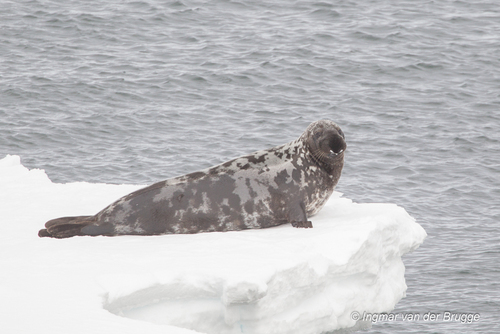
Hooded Seal
Cystophora cristata
A champion of the deep North Atlantic, the Hooded Seal is famous for the male's bizarre, inflatable red nasal display and the world's shortest childhood. These solitary wanderers navigate the shifting pack ice, spending their lives between the freezing surface and the dark depths of the ocean.
Quick Identification
Size
Males average 2.5–2.7 m (8.2–8.9 ft) and 400 kg (880 lbs); females are smaller at 2–2.2 m (6.6–7.2 ft) and 300 kg (660 lbs).
Colors
Silver-grey coat with irregular black blotches; pups (blue-backs) are slate blue on the back with creamy white bellies.
Key Features
- Inflatable black nasal 'hood' in males
- Bright red nasal septum balloon displayed by males
- Large, robust body with silver-grey spotted coat
- Pups have distinct blue-grey fur known as 'blue-back'
- Short, wide muzzle and large dark eyes
When You’ll See Them
Geographic range
Where Does the Hooded Seal Live?
Native to the North Atlantic and Arctic Oceans, the Hooded Seal's world revolves around the shifting pack ice stretching from the Svalbard archipelago in the east to the Gulf of St. Lawrence in the west. These seals are most concentrated in four major breeding areas: the Davis Strait, the 'Front' off the coast of Newfoundland, the Gulf of St. Lawrence, and the 'West Ice' near Jan Mayen island. While they are true wanderers of the high seas, individuals are occasionally spotted as far south as the Canary Islands or even the Caribbean, showcasing their nomadic potential.
Basemap © OpenStreetMap contributors
Behavior
Hooded Seals are among the most solitary and aggressive of the phocid species. Unlike many other seals that congregate in large colonies, these animals prefer to remain alone or in small, temporary groups during the breeding and molting seasons. They are remarkably deep divers, capable of reaching depths of over 1,000 meters and staying submerged for nearly an hour, though most dives are shorter and shallower in search of prey.
Perhaps their most famous behavior is the male's visual display. To defend territory or attract mates, males inflate a black 'hood' or bladder on their forehead. If further intimidation is needed, they can blow a bright red, balloon-like membrane out of one nostril. This species also holds the record for the shortest weaning period of any mammal; pups are nursed for only four days, during which they double their weight before being left to fend for themselves on the ice.
EverydayEarth exclusive
Camera Tips
Capturing a Hooded Seal on camera requires specialized placement because they are rarely found on land. If you live in a coastal region where they haul out—such as parts of Newfoundland or Norway—place your camera on high-profile rocky outcrops or near the edge of stable ice floes. Because these seals are aggressive and possess a powerful bite, use a rugged, weatherproof housing and ensure the camera is securely mounted to resist curious investigation or accidental bumping by a 400kg animal.
Set your camera for high-speed bursts or short video clips. The most sought-after footage is the male's nasal inflation, which happens very quickly during social interactions. A fast trigger speed (under 0.3 seconds) is essential to catch the moment the red 'balloon' emerges from the nostril. Since the Arctic and North Atlantic environments are often bright due to snow and ice, adjust your exposure compensation to -0.5 or -1.0 to prevent the white ice from 'blowing out' the image and losing detail on the seal's silver coat.
For timing, the month of March is the 'Golden Hour' for Hooded Seal photography. This is when they gather on the ice for a very brief window to pup and breed. If you are using a camera in low-light Arctic winters, ensure you have high-quality lithium batteries, as standard alkaline batteries will fail instantly in the sub-zero temperatures these seals call home. Aim for a wide-angle lens if possible; these are large animals and you’ll want to capture the vast, icy landscape that defines their existence.
Similar Species
Species that look similar or are commonly confused with Hooded Seal.
Frequently Asked Questions
Record Hooded Seal at your habitat
Connect a camera to start building your own species record — AI identifies every visitor automatically.