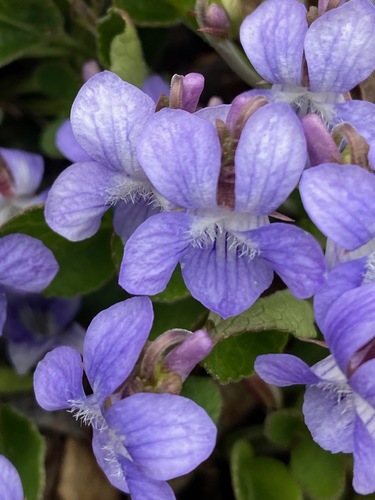
hookedspur violet
Viola adunca
The hookedspur violet is a hardy spring gem that transforms forest floors and meadows into a sea of purple. As a vital host plant for rare butterflies, this tiny wildflower is a powerhouse of backyard biodiversity.
Quick Identification
Size
A low-growing perennial standing 2-10 cm (1-4 inches) tall with a similar spread.
Colors
Petals range from deep violet to pale blue with a white or yellowish throat; features dark purple 'nectar guide' veins.
Key Features
- Distinctive long nectar spur that is typically hooked or curved at the end
- Heart-shaped leaves with subtle rounded teeth along the margins
- Five-petaled flowers with the side petals often featuring fine hairs (bearded)
- Low-growing, clump-forming habit that emerges early in the spring
When You’ll See Them
Geographic range
Where Does the hookedspur violet Live?
Native to the North American continent, the hookedspur violet boasts a massive geographic footprint. It is widely distributed across the northern contiguous United States and throughout nearly every province in Canada. From the mist-soaked coastal cliffs of the Pacific Northwest to the high-elevation meadows of the Rocky Mountains and the Great Lakes region, this violet is a staple of the northern temperate landscape. While it is primarily a wild species, it is increasingly found in native plant gardens and restored suburban meadows across its native range.
Basemap © OpenStreetMap contributors
Behavior
The hookedspur violet is one of the earliest bloomers in the wild, often appearing while the ground is still cool from winter. Unlike many garden varieties, this native wildflower is a resilient survivor that has adapted to everything from coastal dunes to high-altitude meadows. It spreads both through seeds and short rhizomes, forming small, vibrant patches that provide a critical nectar source for early-emerging bees and butterflies.
Perhaps its most fascinating 'behavior' is its ecological partnership with the Silver-spotted Fritillary and other Speyeria butterflies. The violet acts as a primary host plant; the butterflies lay their eggs near the violets, and the hatched larvae rely almost exclusively on these leaves for food. In the backyard setting, these flowers are unobtrusive but provide a vital burst of color and life before most larger shrubs have even begun to bud.
EverydayEarth exclusive
Camera Tips
To capture the hookedspur violet on a trail camera or backyard AI camera, you need to think small and low. Since these plants rarely exceed four inches in height, your camera should be mounted just a few inches off the ground. Use a macro lens attachment if available, or ensure your camera has a short minimum focus distance. Angling the camera slightly upward can help capture the distinctive 'hooked spur' on the back of the flower, which is its most defining characteristic.
Timing is everything when it comes to violets. The best footage is captured during the 'golden hours' of early morning or late afternoon when the purple petals are saturated by soft light. Because these flowers are early-season bloomers, set your cameras out as soon as the snow melts or the first spring rains arrive. If your camera is triggered by motion, you may not catch the plant itself moving, but you will capture the incredible array of pollinators, like mason bees and fritillary butterflies, that visit the blooms.
If you are using an AI-powered camera to identify wildlife visiting the violet, place the plant in a spot with high visibility away from tall, swaying grass that might cause 'false triggers.' A clean, mulched area or a rocky outcrop makes for a perfect backdrop. Keep the lens clean from mud splashes, as spring rain can easily coat a low-mounted camera. For the best results, look for a cluster of blooms rather than a single flower to increase the chances of capturing insect interactions.
Similar Species
Species that look similar or are commonly confused with hookedspur violet.
Frequently Asked Questions
Record hookedspur violet at your habitat
Connect a camera to start building your own species record — AI identifies every visitor automatically.