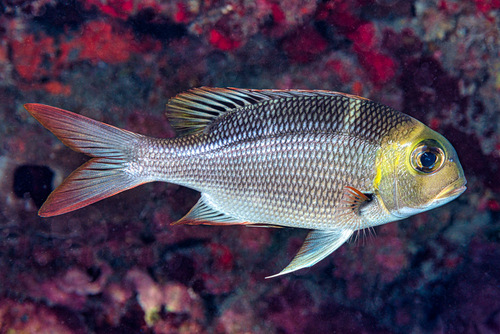
Humpnose Bigeye Bream
Monotaxis grandoculis
With its iconic oversized eyes and rugged, humped profile, the Humpnose Bigeye Bream is a master of the nocturnal reef. This hardy predator is a favorite for underwater observers across the Indo-Pacific, known for its silent daytime vigils and powerful nighttime hunts.
Quick Identification
Size
Typically 30-45 cm (12-18 in), with a maximum length of 60 cm (24 in); can weigh up to 6 kg (13 lbs).
Colors
Adults are silvery-grey with a yellowish or reddish tint on the fins; juveniles feature four distinct black vertical bars on a white-silver body.
Key Features
- Oversized eyes positioned high on the head
- Distinctive 'humped' forehead profile above the eyes
- Strong, molar-like teeth for crushing shells
- Silver-grey scales with a pearly or iridescent sheen
When You’ll See Them
Geographic range
Where Does the Humpnose Bigeye Bream Live?
This species is widely distributed across the tropical Indo-Pacific region, spanning from the Red Sea and the eastern coast of Africa all the way to the Hawaiian and Line Islands. It is a common resident of the Great Barrier Reef in Australia, the Japanese archipelago, and throughout the diverse island chains of Southeast Asia and Oceania. While it is strictly a marine species, it occupies a vast latitudinal range within the warm current systems of the Indian and Pacific Oceans.
Basemap © OpenStreetMap contributors
Behavior
The Humpnose Bigeye Bream is primarily a nocturnal creature that exhibits a unique 'rest' phase during the daylight hours. During the day, they are typically found hovering almost motionlessly in small, loose groups or as solitary individuals near reef drop-offs, under ledges, or around large coral heads. This behavior, often called 'sleep-swimming,' allows them to conserve energy while remaining vigilant against predators in the safety of the reef structure.
As the sun sets, their behavior shifts dramatically. They become active hunters, dispersing from their daytime shelters to forage over nearby sandy flats and rubbly areas. While they are not overly aggressive toward humans, they are quite wary and will maintain a safe distance from divers. They are known for their longevity and can be quite site-faithful, returning to the same reef sections day after day.
EverydayEarth exclusive
Camera Tips
Capturing the Humpnose Bigeye Bream on an underwater AI camera is best achieved by targeting their 'daytime hangouts.' Look for large coral 'bommies' or overhangs where the current is minimal. Position your camera on a weighted tripod at the edge of these structures, aiming slightly upward to capture their silhouette against the filtered surface light. Because they remain relatively stationary during the day, you can get high-detail shots if the water clarity is good.
For nighttime footage, which reveals their active hunting state, move your camera to the 'transition zone' where the reef meets the sand. This is where they forage for crunchy invertebrates. Use a camera with high-sensitivity infrared capabilities to avoid scaring them with bright white lights, which can cause them to dart away. A slow-pulsing or dim red light can also attract curious crustaceans, which in turn might bring the Bream directly in front of your lens.
Stability is key when filming this species. Use a heavy base to prevent the camera from swaying in the surge, as the Humpnose Bigeye Bream is wary of erratic movements. If you are using an AI-powered trigger, set it to a medium sensitivity; their slow movement during the day might be ignored by some motion sensors, while their quick strikes at prey during the night require a fast trigger speed to capture the action.
Similar Species
Species that look similar or are commonly confused with Humpnose Bigeye Bream.
Frequently Asked Questions
Record Humpnose Bigeye Bream at your habitat
Connect a camera to start building your own species record — AI identifies every visitor automatically.