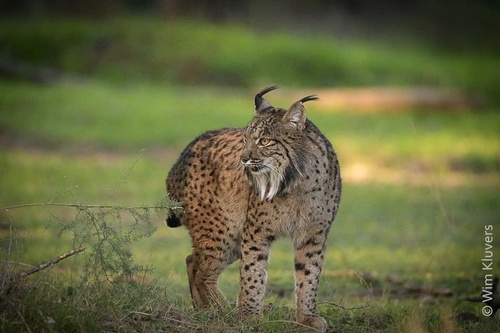
Iberian Lynx
Lynx pardinus
Once the world's most endangered feline, the Iberian lynx is a testament to conservation success. Known for its striking facial ruff and tufted ears, this phantom of the Mediterranean scrubland is a master of the Iberian wild.
Quick Identification
Size
Length: 85–110 cm (33–43 in); Height: 60–70 cm (24–28 in); Weight: 9–15 kg (20–33 lbs)
Colors
Tawny to yellowish-red coat with distinct dark brown or black spots; white underbelly; black ear tufts and a dark-tipped tail.
Key Features
- Long black ear tufts resembling brushes
- Distinctive 'beard' or facial ruff of long hair
- Short, bobbed tail with a solid black tip
- Spotted coat pattern unique to each individual
When You’ll See Them
Geographic range
Where Does the Iberian Lynx Live?
The Iberian lynx is native to the southwestern corner of Europe, found exclusively on the Iberian Peninsula. Its core range is currently limited to isolated pockets in southern and central Spain, specifically in Andalusia, Extremadura, and Castilla-La Mancha, as well as parts of southeastern Portugal. While historically widespread across the peninsula, modern populations are the result of highly successful reintroduction programs in protected parklands and private estates.
Basemap © OpenStreetMap contributors
Behavior
The Iberian lynx is a highly specialized predator known for its solitary and territorial nature. Unlike some other wild cats, it is a master of the 'wait and pounce' strategy, relying on dense Mediterranean scrubland for cover while stalking its prey. While they are mostly active during the twilight hours of dawn and dusk, their activity patterns can shift during the winter, becoming more diurnal to match the habits of the rabbits they hunt.
These cats are generally elusive and avoid human contact, though they have begun to reappear in rural areas bordering human settlements due to intensive conservation efforts. Males and females maintain separate territories that only overlap during the breeding season. They communicate through scent marking and a variety of vocalizations, though they are much quieter than most other feline species, relying on visual signals like their twitching ear tufts.
EverydayEarth exclusive
Camera Tips
Capturing an Iberian lynx on camera requires patience and strategic placement in Mediterranean landscapes. Aim to place your camera along 'corridors'—natural clearings between dense thickets of gorse or mastic. These cats prefer to travel along existing dirt tracks or the edges of scrubland rather than pushing through the densest brush. Set your camera height at approximately 40 centimeters (16 inches) to capture the lynx's side profile and distinctive facial ruff, which is essential for individual identification by researchers.
Water is the best natural lure in the arid regions where these cats live. If you have a trail camera near a known permanent water hole or a 'charca' (pond) during the dry summer months, your chances of a sighting increase significantly. Avoid using food bait; these cats are specialist hunters of live rabbits and are rarely interested in carrion or commercial lures. Instead, look for 'latrines'—communal scat sites—which they visit frequently to mark their territory and communicate with other lynxes.
Regarding camera settings, a fast trigger speed (under 0.3 seconds) is vital, as lynxes move with a fluid, constant gait. Because they are most active during the low-light hours of crepuscular periods, ensure your camera has a high-quality infrared flash that won't spook the animal but provides enough clarity to see the spot patterns on their coat. In the winter months, you might even catch them moving during the day, so use a hybrid mode that captures both high-resolution photos and short video clips to observe their unique social behaviors.
Similar Species
Species that look similar or are commonly confused with Iberian Lynx.
Frequently Asked Questions
Record Iberian Lynx at your habitat
Connect a camera to start building your own species record — AI identifies every visitor automatically.