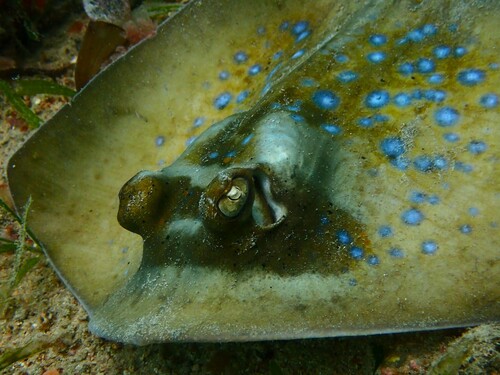
Indian Ocean Blue-spotted Maskray
Neotrygon indica
A striking bottom-dweller of the tropical Indian Ocean, the Blue-spotted Maskray is famous for its vivid cerulean spots and a mysterious dark band across its eyes. Mastering the art of camouflage, it spends its days hidden beneath the sand of coastal reefs.
Quick Identification
Size
Disc width 20-30 cm (8-12 in); total length up to 45 cm (18 in)
Colors
Sandy brown or yellowish-tan disc covered in vivid, medium-sized blue spots; a dark, mask-like band across the eyes; white or cream underside
Key Features
- Electric blue spots scattered across a tan disc
- Distinct dark 'mask' marking across the eyes
- Kite-shaped body with a relatively short, tapering tail
- Two venomous spines located on the tail
When You’ll See Them
Geographic range
Where Does the Indian Ocean Blue-spotted Maskray Live?
The Indian Ocean Blue-spotted Maskray is primarily native to the northern and eastern reaches of the Indian Ocean. Its core population is concentrated in the coastal waters of India and Sri Lanka, extending eastward toward the Andaman Sea and the shores of Myanmar and Thailand. While it is a marine specialist, it is frequently found in very shallow near-shore environments including estuaries and reef flats across Southern Asia.
Basemap © OpenStreetMap contributors
Behavior
The Indian Ocean Blue-spotted Maskray is a largely solitary bottom-dweller that spends a significant portion of its life in a state of watchful stillness. To avoid predators such as hammerhead sharks, it frequently buries itself in the substrate, using its pectoral fins to fan sand over its back until only its eyes and spiracles are visible. This behavior serves as both a defensive mechanism and an ambush strategy for catching unsuspecting prey.
When active, this ray exhibits a graceful, undulating swimming motion, gliding just inches above the seafloor. It is generally timid around humans and will typically swim away rapidly if disturbed. However, if accidentally stepped on by waders in shallow water, it will whip its tail upward to deploy its venomous stings. Socially, they are not known to form large schools, though they may gather in higher densities in nutrient-rich seagrass beds or during specific tidal cycles.
EverydayEarth exclusive
Camera Tips
Capturing the Indian Ocean Blue-spotted Maskray requires a specialized approach since they are entirely aquatic. If you are using an AI-powered underwater camera or a waterproof trail cam, placement is everything. Position your camera on a weighted tripod or a flat rock overlooking a sandy 'clearing' near a coral reef edge. These rays love transition zones where the reef meets the sand, as they provide both cover and hunting grounds.
Since these rays often bury themselves, a side-on angle is less effective than a slightly elevated 'downward' view. This perspective helps the AI identify the distinctive blue spots and the eye mask even when the ray is 80% submerged in sand. If your camera setup allows for it, avoid using high-intensity white lights at night, as these can spook the rays; instead, utilize red-filtered lights or high-sensitivity sensors to capture their nocturnal foraging behavior.
To attract a maskray to your camera's field of view, you can use a scent-based lure. A perforated PVC tube filled with crushed oily fish or shellfish (like shrimp shells) secured to the seafloor will create a 'scent trail' that the ray's sensitive electroreceptors and olfactory organs will follow. Ensure the bait is secured so that larger scavengers don't drag it out of the frame.
Be mindful of the tides when setting your equipment. Many maskrays move into very shallow flats during the incoming tide and retreat to deeper water as the tide goes out. Setting your camera in a location that remains submerged at a depth of 1-3 meters during low tide is often the 'sweet spot' for consistent sightings.
Frequently Asked Questions
Record Indian Ocean Blue-spotted Maskray at your habitat
Connect a camera to start building your own species record — AI identifies every visitor automatically.