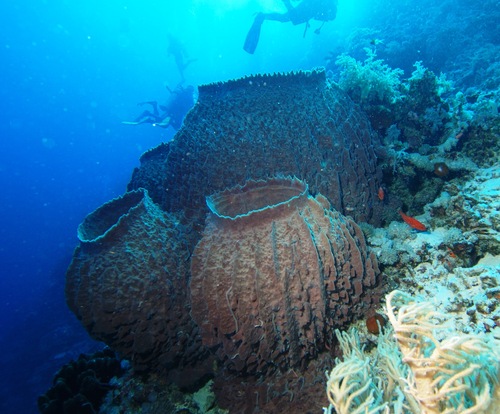
Indo-Pacific Giant Barrel Sponge
Xestospongia testudinaria
Ancient, enormous, and essential, the Indo-Pacific Giant Barrel Sponge is a living skyscraper of the sea. These 'redwoods of the reef' can live for over a millennium, filtering vast oceans of water while providing a home for countless marine species.
Quick Identification
Size
A massive species reaching 1 to 2.5 metres (3.3 to 8.2 feet) in height and diameter.
Colors
Typically reddish-brown, maroon, or brownish-pink; older specimens may appear greyish or pale due to bleaching or silt.
Key Features
- Large barrel-shaped body with a deep central cavity called an osculum
- Hard, stony, or leathery exterior with prominent vertical ridges
- Reddish-brown to grey-maroon coloration
- Lacks any visible movement or appendages
When You’ll See Them
Geographic range
Where Does the Indo-Pacific Giant Barrel Sponge Live?
The Indo-Pacific Giant Barrel Sponge is a majestic fixture of the tropical waters across the Indo-Pacific region. Its native range is anchored in the 'Coral Triangle,' stretching from the northern coast of Australia and the Great Barrier Reef through the islands of Indonesia, Malaysia, and the Philippines. Beyond this core area, it can be found as far west as the coasts of East Africa and Madagascar and as far east as the various island nations of the South Pacific, thriving in warm, nutrient-rich marine environments.
Basemap © OpenStreetMap contributors
Behavior
The Indo-Pacific Giant Barrel Sponge is often called the 'redwood of the reef' due to its impressive size and extreme longevity, with some individuals estimated to be over 1,000 years old. As a sessile filter feeder, it remains anchored to the reef for its entire adult life, pumping thousands of litres of seawater through its body every day to extract oxygen and microscopic food particles. This constant filtration makes it a vital 'kidney' for the reef ecosystem, maintaining water clarity and cycling nutrients.
While they may look like inanimate objects, these sponges are centers of biological activity. They provide critical habitat for various marine life, including gobies, shrimps, and crabs that live within their ridges or deep inside the central cavity. They also engage in a fascinating symbiotic relationship with cyanobacteria, which live within the sponge's tissues and provide extra nutrients through photosynthesis in exchange for a stable home. They are famously known for 'smoking' during mass spawning events, where they release clouds of reproductive cells into the water column.
EverydayEarth exclusive
Camera Tips
To capture the majesty of an Indo-Pacific Giant Barrel Sponge, you will need an underwater camera setup or a specialized waterproof trail camera if you are monitoring a shallow reef or dock area. Position the camera at a slightly upward angle from the base of the sponge; this 'low-angle' perspective emphasizes its massive barrel-like structure against the backdrop of the water column. Because these sponges are stationary, they are perfect subjects for testing high-resolution settings or experimenting with long-exposure shots to capture the movement of surrounding fish.
Lighting is the biggest challenge when photographing sponges at depth. As you go deeper, red light is the first color to be absorbed by the water, which can make the sponge look dull and grey. Use a high-quality underwater video light or a red filter on your lens to bring back the natural maroon and brownish-red tones of the sponge's 'skin.' If you are using a stationary camera for long-term monitoring, ensure it is weighted properly or attached to a non-living substrate to prevent it from shifting with the currents or tides.
For a truly unique capture, set your camera to time-lapse mode. While the sponge itself doesn't move, a time-lapse can reveal the incredible volume of life that interacts with it, such as small fish darting into the osculum for safety or the slow movement of crinoids and sea stars across its surface. If you are monitoring during a full moon in certain seasons, keep your camera running to catch a rare spawning event, where the sponge appears to emit 'smoke' as it releases gametes into the sea. Avoid placing cameras directly inside the osculum, as this can disrupt the sponge's internal water flow.
Frequently Asked Questions
Record Indo-Pacific Giant Barrel Sponge at your habitat
Connect a camera to start building your own species record — AI identifies every visitor automatically.