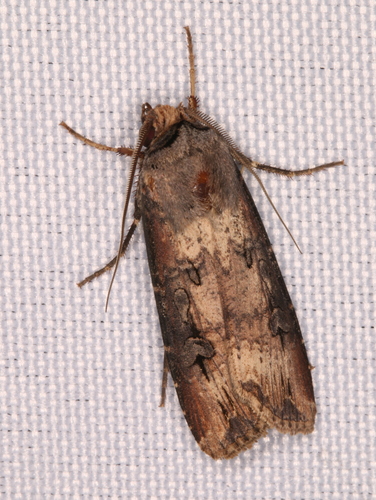
Ipsilon Dart Moth
Agrotis ipsilon
A champion of the night sky, the Ipsilon Dart Moth is a migratory marvel identified by the distinctive 'dagger' marks on its wings. While its larvae are famous garden residents, the adult moth is a sophisticated nocturnal visitor to backyards worldwide.
Quick Identification
Size
Wingspan of 40–55 mm (1.6–2.2 inches); body length approximately 22–26 mm (0.9–1.0 inch)
Colors
Earthy browns and grays; forewings are dark with a pale outer area and a distinct black 'dagger' mark. Males have more feathery antennae than females.
Key Features
- Distinctive black Y-shaped or 'dagger' marking on the outer forewing
- Pearly white hindwings with dark veins
- Stocky, furry thorax typical of Noctuidae
- Two prominent spots (circular and kidney-shaped) on the upper wing
When You’ll See Them
Behavior
The Ipsilon Dart Moth is a highly mobile and migratory species, famous for its ability to travel hundreds of miles using seasonal wind currents. While they are found globally, their presence in northern latitudes is often the result of an annual migration from warmer climates. They are strictly nocturnal, spending their nights seeking out nectar-rich flowers or searching for mates, while hiding in leaf litter or crevices during the day to avoid predators.
In the garden, these moths are often recognized more by their larval stage—the Black Cutworm. These larvae are notorious for 'cutting' young seedlings at the soil line during the night. However, the adult moths are harmless pollinators that visit a wide variety of flowers. They are particularly drawn to fermented scents and artificial light sources, making them a common sight around porch lights and garden lanterns.
EverydayEarth exclusive
Camera Tips
To capture the Ipsilon Dart Moth on your AI camera, you need to create a 'station' because their small size and speed make random captures difficult. The most effective method is 'sugar baiting.' Mix overripe bananas, brown sugar, and a bit of molasses or beer into a thick paste and let it sit for a day to ferment. Paint this mixture onto a tree trunk at eye level. Position your camera on a tripod roughly 3 to 4 feet away, ensuring it is within its minimum focus range. This lure is irresistible to the Ipsilon Dart and will keep them stationary long enough for a clear ID.
Since these moths are nocturnal, your camera will rely on its infrared (IR) flash. To prevent the moth's wings from looking like a white blur (a common issue with reflective insect scales), try placing a small piece of frosted tape over the IR LED to diffuse the light. This creates a softer glow that reveals the intricate 'Y' markings on the wings rather than washing them out. Set your camera to 'Photo' mode with a 3-shot burst to catch the perfect moment when the wings are still.
Another excellent setup involves using a white sheet and a UV light (blacklight). Hang the sheet and place the light in front of it, then aim your camera at the center of the sheet. The Ipsilon Dart is highly phototactic and will likely land on the fabric and rest there for several minutes. This provides a high-contrast, flat background that helps AI-powered cameras identify the species much more accurately than a busy garden background. Check your camera daily during humid, warm nights when moth activity is at its peak.
Frequently Asked Questions
Record Ipsilon Dart Moth at your habitat
Connect a camera to start building your own species record — AI identifies every visitor automatically.