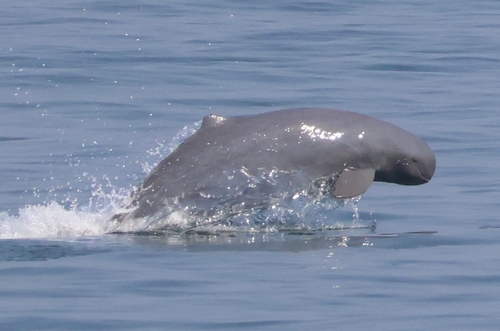
Irrawaddy Dolphin
Orcaella brevirostris
The Irrawaddy dolphin is a gentle, blunt-nosed marvel of Asia's coastal and river waters. Famed for its cooperative fishing with local villagers and its unique 'smiling' face, this endangered mammal is a vital indicator of healthy aquatic ecosystems.
Quick Identification
Size
Length: 2–2.75 m (6.6–9 ft); Weight: 90–200 kg (200–440 lb)
Colors
Slate gray to slate blue body with a lighter grayish-white underside; no distinct stripes or spots
Key Features
- Rounded, blunt forehead with no protruding beak
- Small, triangular dorsal fin with a rounded tip located behind the mid-body
- Flexible neck capable of turning the head independently
- Broad, paddle-like flippers
When You’ll See Them
Geographic range
Where Does the Irrawaddy Dolphin Live?
Native to the coastal and riverine regions of South and Southeast Asia, the Irrawaddy dolphin is found in fragmented populations from the Bay of Bengal to the Philippine islands. Its core range includes the major river systems of Myanmar, Cambodia, and Indonesia, as well as unique lagoon environments like Chilika Lake in India and Songkhla Lake in Thailand. Because they are euryhaline, they thrive in the transition zones where rivers meet the sea, though they never venture far from the shoreline into deep oceanic waters.
Basemap © OpenStreetMap contributors
Behavior
Irrawaddy dolphins are known for their shy, cautious nature, often avoiding boats and rarely engaging in the acrobatic leaping or bow-riding common in other dolphin species. They are slow swimmers that surface in a rolling motion, typically lifting only the top of their head and back out of the water. One of their most unique physical traits is a flexible neck, which allows them to turn their heads—a rare feature among cetaceans that helps them navigate the complex, often murky environments of tropical rivers and mangroves.
Socially, they are usually found in small pods of 2 to 6 individuals, though larger congregations may form where food is abundant. They are famous for their remarkable cooperative fishing behavior with local humans in the Ayeyarwady and Mekong rivers. The dolphins herd schools of fish toward the fishers' nets and signal with splashes when it is time to cast; in exchange, the dolphins feast on the fish that scatter from the nets. They are also known to spit spurts of water from their mouths, which is believed to help them herd fish or clear silt.
EverydayEarth exclusive
Camera Tips
Capturing the Irrawaddy dolphin on a trail camera requires a specialized setup focused on riverbanks or coastal overlooks. If you have a property facing a known habitat, mount your camera on a high vantage point like a pier, jetty, or a sturdy tree overhanging the water. The ideal height is 3 to 5 meters above the high-tide line to prevent salt spray from clouding the lens while providing a wide field of view. Angle the camera downward at a 20-30 degree angle to capture the water's surface where they break to breathe.
Use a camera with a very fast trigger speed (0.2 seconds or less) and set it to 'Burst Mode' or 'High-Speed Video.' Irrawaddy dolphins surface quickly and subtly; they don't jump high out of the water, so you need multiple frames to catch the characteristic rounded forehead or small dorsal fin. If your camera supports it, a polarizing filter is a game-changer for reducing sun glare on the water, allowing the camera to see 'through' the surface to capture the dolphin's silhouette.
While you cannot use bait in the traditional sense, focus your camera placement on 'bottleneck' areas like the mouth of a mangrove creek or deep pools in a river channel where fish congregate during low tide. In river settings, the dry season is the best time for monitoring, as the receding water concentrates the population into predictable deep-water zones. For nighttime monitoring, ensure your camera uses 'No-Glow' Infrared (black LEDs) to avoid startling these shy animals, although their activity is most easily documented during the daylight hours when the water surface is visible.
Similar Species
Species that look similar or are commonly confused with Irrawaddy Dolphin.
Frequently Asked Questions
Record Irrawaddy Dolphin at your habitat
Connect a camera to start building your own species record — AI identifies every visitor automatically.