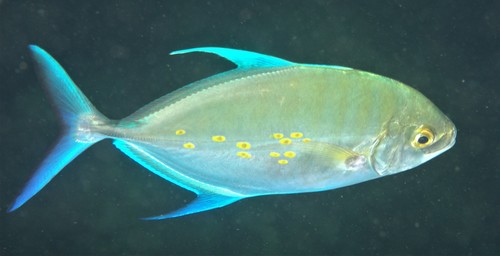
Island Jack
Ferdauia orthogrammus
An elegant and fast-moving predator of the Indo-Pacific, the Island Jack is easily recognized by its golden spots and sleek, silvery profile. It is a specialist of remote island reefs, bringing a flash of gold to the crystal-clear blue depths.
Quick Identification
Size
Typically 30-50 cm (12-20 in), reaching a maximum length of 75 cm (29.5 in) and a weight of 6.6 kg (14.5 lbs)
Colors
Silvery iridescent body with a bluish-green back; distinguished by several small yellow-to-gold spots scattered along the mid-body
Key Features
- Angular and steeply sloping snout profile
- Small, distinct yellow-gold spots on the sides
- Silvery scales with a metallic blue-green sheen on the dorsal side
- Deeply forked tail and narrow tail base
When You’ll See Them
Geographic range
Where Does the Island Jack Live?
The Island Jack is a widespread inhabitant of the tropical and subtropical waters spanning the Indian and Pacific Oceans. It is primarily found in the island chains of the Indo-Pacific, ranging from the eastern coast of Africa and Mozambique across to the central Pacific islands like Hawaii and the Line Islands. While it is almost entirely absent from continental shelf environments, it thrives around remote oceanic outposts such as the Seychelles, the Maldives, and the Revillagigedo Islands off the coast of Mexico.
Basemap © OpenStreetMap contributors
Behavior
The Island Jack is a highly active marine predator known for its speed and agility. Unlike many of its relatives in the jack family that frequent continental coastlines, this species is an island specialist. It is most commonly found patrolling the clear waters of lagoons and seaward reefs, where it moves in small, synchronized schools of five to fifteen individuals. Larger adults are occasionally observed hunting solo along the edges of deep drop-offs.
These fish are known for their inquisitive nature, often approaching underwater structures or slow-moving observers. They are not aggressive toward humans but are formidable hunters of smaller marine life. Their social structure is relatively loose, allowing them to join mixed-species foraging groups, often following larger rays or sharks to snatch up prey disturbed by the larger animals' movement along the seabed.
EverydayEarth exclusive
Camera Tips
Capturing high-quality footage of an Island Jack requires an underwater camera setup, such as a GoPro or a specialized marine trail cam with a waterproof housing. Because these fish are attracted to the edges of reefs and sandy channels, you should mount your camera at a depth of 3 to 10 meters on a stable, weighted base or a pier piling. Aim the lens toward 'blue water' or open channels where current flow is strongest, as Island Jacks use these currents to transit between hunting grounds.
Lighting is the most critical factor for capturing the Island Jack's vibrant colors. Position your camera to take advantage of midday sun (10 AM to 2 PM), which provides the best penetration to highlight the iridescent blue of their backs and the signature gold spots on their flanks. If your camera supports high-frame-rate recording, set it to at least 60fps to capture their fast, darting movements without motion blur. Using a red filter can also help restore the natural colors that are often lost at depth.
To attract Island Jacks to your 'underwater backyard' or dock camera, consider using a bait cage. Fill a mesh bag with oily fish like sardines or mackerel and secure it just out of the camera's frame. This will attract smaller reef fish, which in turn will draw in the predatory Island Jacks. Be patient, as these fish may circle the area several times before moving close to the lens. Ensure your motion trigger sensitivity is high, as their silvery skin can sometimes blend into the bright surface reflections, making them harder for some AI sensors to detect initially.
Similar Species
Species that look similar or are commonly confused with Island Jack.
Bluefin Trevally
Bluefin Trevally have brilliant electric-blue fins and small dark spots on their upper body, whereas Island Jacks have yellow-gold spots and a more angular snout.
Golden Trevally
Golden Trevally have much larger, more prominent black bars and a more golden overall body color when young, and lack the specific small gold spots seen on the Island Jack.
Frequently Asked Questions
Record Island Jack at your habitat
Connect a camera to start building your own species record — AI identifies every visitor automatically.