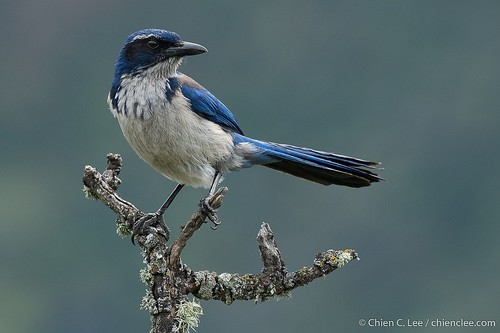
Island Scrub-Jay
Aphelocoma insularis
Meet North America's rarest jay, a brilliant blue architect of the forest found only on a single island off the California coast. Bold, brilliant, and incredibly smart, the Island Scrub-Jay is a true evolutionary wonder.
Quick Identification
Size
28–34 cm (11–13.5 in) length; wingspan of approx 39 cm (15.5 in); 100–130 g (3.5–4.6 oz)
Colors
Deep ultramarine blue head, wings, and tail; brownish-gray mantle (back); white throat with a dark blue 'necklace' or breast band. Males and females look similar, though males are slightly larger.
Key Features
- Striking deep ultramarine blue plumage
- Larger and darker than mainland scrub-jays
- Strong, heavy black bill
- Bold white eyebrow stripe above the eye
When You’ll See Them
Sightings on EverydayEarth
Jul 1, 2026
An Island Scrub-Jay perches on the left side of a large stick nest, remaining relatively still as it looks out over the landscape. Meanwhile, a smaller House Finch is seen hopping through the sticks on the right side of the nest, appearing to forage among the debris.
Jun 30, 2026
An Island Scrub-Jay lands on the edge of the large eagle nest and hops toward the center, carefully inspecting and poking at the nesting material.
Jun 28, 2026
An Island Scrub-Jay is actively foraging within the bowl of a large stick nest. It hops around the nesting material, tilting its head to inspect the debris, likely searching for insects or food scraps left behind by the nest's usual inhabitants.
Jun 28, 2026
An Island Scrub-Jay perches on a stout branch forming the outer structure of a large stick nest. The bird remains stationary for several seconds, looking around its environment, before flying off to the right.
May 29, 2026
An Island Scrub-Jay is seen hopping along the edge of a large stick nest. It moves purposefully across the branches, occasionally pecking at the dry nesting material in search of insects or food scraps.
May 23, 2026
An Island Scrub-Jay perches prominently on a dry branch, scanning its surroundings. It turns its head frequently and briefly fluffs its feathers while looking toward the camera.
Geographic range
Where Does the Island Scrub-Jay Live?
The Island Scrub-Jay is found exclusively on Santa Cruz Island, one of the Channel Islands located off the coast of Southern California in the United States. This remarkable bird holds the title of the only insular endemic landbird species in North America, meaning its entire global population is restricted to this single 96-square-mile island. It does not naturally occur on the California mainland or any of the other neighboring islands, making it a true biological treasure of the Pacific.
Basemap © OpenStreetMap contributors
Behavior
The Island Scrub-Jay is a highly intelligent and curious member of the crow family (Corvidae). These birds are famous for their remarkable spatial memory; they spend much of the late summer and fall 'caching' thousands of acorns in the ground, which they rely on for food during the winter. Interestingly, they often forget where some acorns are buried, making them vital foresters that help regenerate the island's oak woodlands.
Socially, they are bold and assertive, often defending large year-round territories in mated pairs. Unlike many other island species that lose their fear of predators, the Island Scrub-Jay remains alert and vocal, often emitting a harsh, rasping 'shreep' call to announce its presence. They are non-migratory and spend their entire lives within a few miles of where they hatched.
EverydayEarth exclusive
Camera Tips
Because the Island Scrub-Jay is restricted to Santa Cruz Island, your camera setup will likely be in a rugged, coastal environment. To capture their best behavior, focus on water. Fresh water is a precious resource on the island, so placing an AI-powered camera near a persistent spring or a sturdy birdbath in a permitted area will yield fantastic results. They are bold birds and will often land right in front of a lens if they feel the area is safe.
Position your camera at a height of 4 to 5 feet, angled toward a sturdy oak branch or a flat rock. These birds love 'launching' points where they can survey the ground before hopping down to forage. If you are setting up near oak trees during the fall, aim the camera at the base of trees where they frequently hide acorns in the leaf litter. The movement of them vigorously digging and caching is a classic behavior to record.
Use a fast shutter speed or a high-frame-rate video setting if possible. Scrub-jays are twitchy and fast-moving; a slow trigger speed will often result in a 'ghost' of blue feathers rather than a crisp image. Since the island sun can be harsh, try to position the camera facing North or South to avoid direct lens flare during the golden hours when the birds are most active.
Similar Species
Species that look similar or are commonly confused with Island Scrub-Jay.
Frequently Asked Questions
Record Island Scrub-Jay at your habitat
Connect a camera to start building your own species record — AI identifies every visitor automatically.