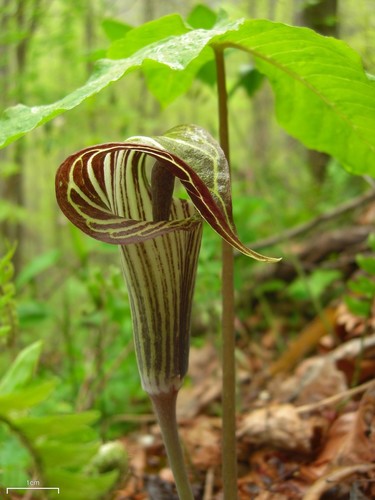
Jack-in-the-Pulpit
Arisaema triphyllum
Meet the forest's master of disguise, a hooded woodland plant that changes its sex and traps pollinators in its distinctive 'pulpit.'
Quick Identification
Size
Stands 30–60 cm (1-2 feet) tall with a leaf spread of up to 45 cm (18 inches).
Colors
Green and deep maroon or purple-brown striped hood (spathe); green central stalk (spadix); bright, waxy red berries in late summer.
Key Features
- Three-parted trifoliate leaves resembling poison ivy
- Hooded 'pulpit' flower structure with a club-shaped interior
- Fleshy, bright red berry clusters in late summer
- Distinctive vertical light-green or purple-brown stripes
When You’ll See Them
Geographic range
Where Does the Jack-in-the-Pulpit Live?
Native to the eastern half of North America, this woodland treasure is found from the Atlantic coast westward to the edge of the Great Plains. Its core range spans from the Gulf of Mexico in the south up through the Great Lakes region and into southeastern Canada, including Ontario and Quebec. Within these regions, it flourishes in the deep, filtered shade of ancient temperate forests and along the margins of freshwater swamps.
Basemap © OpenStreetMap contributors
Behavior
Jack-in-the-Pulpit is a remarkable perennial that performs a unique biological feat: it can change its sex. Known as a sequential hermaphrodite, a single plant can produce only male flowers one year and only female flowers the next. This transition is typically determined by the plant's size and nutrient reserves; smaller, younger plants are usually male, while larger, healthier plants become female to support the energy-intensive process of seed production.
This plant uses a 'trap-and-kill' strategy for pollination. It emits a faint, mushroom-like odor to attract fungus gnats. These tiny insects crawl into the slippery 'pulpit' (the spathe). In male plants, a small hole at the bottom allows the gnats to escape after they are dusted with pollen. However, female plants lack this exit, trapping the gnats inside to ensure they thrash against the flowers and transfer pollen before they eventually perish. While it contains calcium oxalate crystals that are toxic if eaten raw, indigenous groups learned to cook the root (corm) to make it edible, leading to its nickname, the Indian Turnip.
EverydayEarth exclusive
Camera Tips
Capturing the Jack-in-the-Pulpit on a trail camera requires a specialized setup compared to moving wildlife. Because the plant is stationary, use a camera with a high-quality macro mode or a very short focal distance. Mount your camera on a low-profile ground stake or a small tripod, positioning the lens just 6 to 10 inches off the ground. For the most dramatic 'wildlife' style shots, angle the camera slightly upward to peer inside the hooded spathe, revealing the 'Jack' (spadix) and the intricate interior stripes.
The best time to deploy your camera is from late April to early June. To capture the plant's secret life, use a time-lapse setting rather than motion triggers. Set your camera to take a high-resolution photo every 15 to 30 minutes during daylight hours. This allows you to document the spathe slowly unfurling and can even catch the occasional fungus gnat or beetle entering the 'trap.' If your camera supports high-definition video, a 30-second clip during a light breeze can showcase the elegant movement of the large, trifoliate leaves.
Lighting is your biggest challenge in the deep forest understory. Avoid using a heavy flash, which can wash out the subtle greens and purples of the plant. Instead, position your camera to take advantage of 'sun flecks'—the brief moments when sunlight pierces through the tree canopy. This natural spotlighting creates a professional, moody look. For a second seasonal opportunity, return in late August when the berries turn bright red; the high-contrast color against the green forest floor makes for some of the most striking botanical photography possible on a trail cam.
Similar Species
Species that look similar or are commonly confused with Jack-in-the-Pulpit.
Frequently Asked Questions
Record Jack-in-the-Pulpit at your habitat
Connect a camera to start building your own species record — AI identifies every visitor automatically.