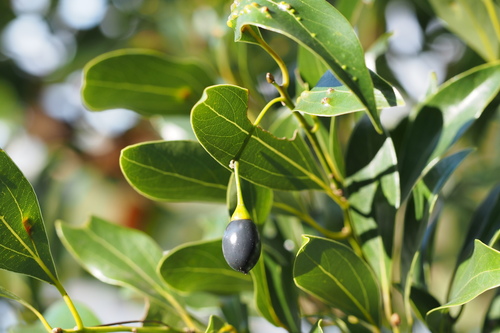
Japanese Cinnamon
Cinnamomum yabunikkei
A fragrant cornerstone of East Asian forests, the Japanese Cinnamon is a haven for pollinators and a winter pantry for birds. Its glossy, three-veined leaves and aromatic bark make it a signature species of the Japanese coastline.
Quick Identification
Size
Typically grows 10-15 meters (33-50 feet) in height with a trunk diameter of 30-50 cm (1-1.6 feet).
Colors
Glossy dark green upper leaf surfaces, pale glaucous green undersides, and gray-brown bark; fruit turns dark purple to black when ripe.
Key Features
- Three prominent veins originating from the leaf base
- Leaves emit a spicy, cinnamon-like aroma when crushed
- Smooth, light gray bark that becomes slightly fissured with age
- Small, inconspicuous yellowish-green flowers in spring
When You’ll See Them
Geographic range
Where Does the Japanese Cinnamon Live?
The Japanese Cinnamon is native to the warm-temperate regions of East Asia. It is found most abundantly across the Japanese archipelago, specifically on the islands of Honshu, Shikoku, and Kyushu. Beyond Japan, its range extends to the Korean Peninsula and parts of Taiwan and coastal China, where it thrives in humid, maritime climates. While it has been introduced to some botanical gardens in the West, it remains firmly rooted in its native Asian coastal habitats.
Basemap © OpenStreetMap contributors
Behavior
The Japanese Cinnamon is a sturdy, evergreen tree that plays a vital role as a structural component of warm-temperate forests. Unlike its more famous relative, the Ceylon cinnamon, this species is primarily appreciated for its ornamental value and its ecological role in providing year-round shelter. It grows at a moderate pace, forming a dense, rounded canopy that offers excellent protection for nesting birds and shade-loving undergrowth.
Ecologically, the tree is a hub of activity. In the spring, its small flowers attract a variety of pollinators, while in the autumn and winter, its oily fruits provide a crucial energy source for migrating and resident birds. While it is not aggressive in a backyard setting, it is deeply integrated into the local insect life, serving as a primary host plant for several specialized butterfly species.
EverydayEarth exclusive
Camera Tips
To capture the best wildlife action around a Japanese Cinnamon, position your camera at a height of 5 to 7 feet, angled slightly downward toward a sturdy branch or a cluster of ripening fruit. During the late autumn months (October and November), the dark purple berries are a major draw for birds like the Brown-eared Bulbul and various thrushes. High-speed shutter settings are recommended to freeze the movement of these quick-moving foragers.
For those interested in entomology, Japanese Cinnamon is the host plant for the Common Bluebottle butterfly (Graphium sarpedon). If your camera has a macro or close-focus mode, aim it at new leaf growth during the spring and summer. This is where you are most likely to capture the fascinating lifecycle of larvae or the rapid, darting flight of the adults as they deposit eggs.
Because the tree is evergreen and provides dense cover, it often serves as a 'highway' for arboreal mammals like squirrels or even Japanese Macaques in certain regions. Placing a camera near a natural fork in the trunk can reveal these hidden commuters. Use a high-quality PIR (passive infrared) sensor setting to ensure the camera isn't triggered by wind-blown leaves, as the glossy foliage of the cinnamon tree can reflect sunlight and cause false triggers on lower-end models.
Frequently Asked Questions
Record Japanese Cinnamon at your habitat
Connect a camera to start building your own species record — AI identifies every visitor automatically.