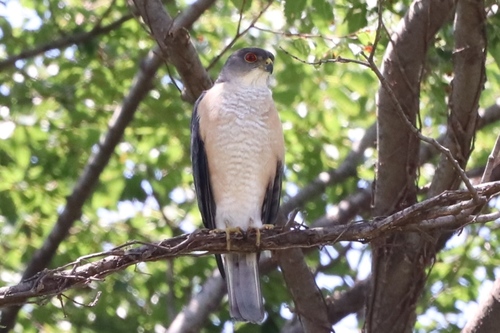
Japanese Sparrowhawk
Tachyspiza gularis
A pint-sized predator with unmatched agility, the Japanese Sparrowhawk is the stealth fighter of East Asian skies. Masterfully navigating through suburban gardens, this small raptor turns backyard bird-watching into a front-row seat for nature's high-speed chases.
Quick Identification
Size
Length: 23–30 cm (9.1–11.8 in); Wingspan: 45–60 cm (18–24 in); Weight: 75–190 g (2.6–6.7 oz)
Colors
Males have slate-grey backs and reddish-brown flanks; females are brownish-grey above with heavy brown barring on a white underside; both have a dark throat stripe.
Key Features
- Small, compact raptor with short, rounded wings and a square tail
- Distinct dark vertical stripe on a white throat
- Yellow cere (nose) and legs
- Fast, darting flight pattern through dense foliage
When You’ll See Them
Geographic range
Where Does the Japanese Sparrowhawk Live?
The Japanese Sparrowhawk is native to East Asia, with its primary breeding grounds located across Japan, the Korean Peninsula, eastern China, and southeastern Russia. As a highly migratory species, it travels vast distances each year to winter in the tropical climates of Southeast Asia, including Indonesia, Malaysia, the Philippines, and Thailand. This broad migratory path makes them a common seasonal visitor across the entire Eastern Palearctic and Indomalayan realms.
Basemap © OpenStreetMap contributors
Behavior
The Japanese Sparrowhawk is a stealthy and agile predator, specifically adapted for life in semi-open woodlands and suburban environments. Unlike larger hawks that spend hours soaring on thermals, this species prefers the 'sit-and-wait' approach. It often perches quietly within the canopy or on a low branch, remaining perfectly still until a small bird or large insect comes within range. Once a target is identified, it launches a lightning-fast pursuit, using its short, rounded wings to bank and weave through tight gaps in the branches.
These hawks are generally solitary, though they are famous for their massive, concentrated migrations. During the spring and autumn, thousands can be seen moving along specific coastal corridors. In a backyard setting, they are usually seen as a 'grey blur' streaking across the garden. While they are wary of humans, they have become increasingly comfortable in suburban areas where bird feeders provide a reliable concentration of their primary food source: small songbirds.
EverydayEarth exclusive
Camera Tips
To capture the Japanese Sparrowhawk on your backyard AI camera, focus your efforts on areas where small songbirds gather. While the hawk won't be interested in birdseed, it is highly attracted to the activity around bird feeders and birdbaths. Position your camera about 5 to 7 feet off the ground, aiming at a clear 'flyway' or a sturdy horizontal branch near a feeder. These hawks often use a specific staging branch to survey the area before diving for a kill.
Because this species moves with incredible speed, standard motion-trigger settings may result in nothing but a blurry tail. If your camera allows, use a 'Sports' or 'High-Speed' mode to increase the shutter speed. If you are using a trigger-based system, set a very short or zero-second lag between captures to ensure you catch the bird as it lands or takes off. They are most active during the early morning and late afternoon when songbirds are busiest.
Lighting is crucial for identifying the sex of the bird. Try to place your camera so it faces north or south, avoiding direct glare from the rising or setting sun, which can wash out the fine barring on the hawk's chest. During the autumn migration, keep your camera active even on overcast days, as these hawks often hunt lower to the ground when the cloud cover is thick. If you have a birdbath, keep the water clean; while they are raptors, they frequently visit water sources to bathe and drink, offering the best chance for a stationary, clear portrait.
Similar Species
Species that look similar or are commonly confused with Japanese Sparrowhawk.
Frequently Asked Questions
Record Japanese Sparrowhawk at your habitat
Connect a camera to start building your own species record — AI identifies every visitor automatically.