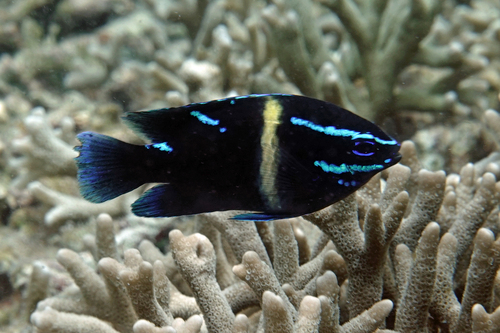
Javanese Damselfish
Neoglyphidodon oxyodon
A pint-sized powerhouse of the Pacific, the Javanese Damselfish dazzles with neon blue stripes and a fierce, territorial spirit. Whether guarding a coral crevice or darting through sunlit lagoons, this vibrant reef resident is a favorite for underwater observers.
Quick Identification
Size
10-15 cm (4-6 inches) in length; weight is negligible, typically under 100g (3.5 oz)
Colors
Juveniles feature a striking velvet black or deep blue body with electric neon blue horizontal stripes and a yellow spot; adults fade to a uniform dusky black or dark brownish-grey.
Key Features
- Brilliant neon blue horizontal stripes on a dark body (juveniles)
- Single yellow or white spot near the rear of the dorsal fin
- Compact, oval-shaped body with a deeply notched tail
- Extremely territorial and aggressive behavior toward intruders
- Dusky black-to-velvet coloration in mature specimens
When You’ll See Them
Geographic range
Where Does the Javanese Damselfish Live?
The Javanese Damselfish is native to the sun-soaked waters of the Indo-West Pacific, primarily centered within the biodiversity hotspot of the Coral Triangle. Its core range includes the sprawling island chains of Indonesia, the Philippines, and Timor-Leste, extending northward toward Taiwan and southward to the northern reaches of Australia. While it is not considered an invasive species globally, its popularity in the aquarium trade means it is occasionally sighted in non-native tropical waters, though established wild populations outside its home range are rare.
Basemap © OpenStreetMap contributors
Behavior
The Javanese Damselfish, often known in the aquarium trade as the Neon Velvet Damselfish, is a high-energy species known for its feisty temperament. In the wild, they are solitary and highly territorial, guarding a specific patch of the reef or a coral head with surprising vigor. While juveniles are prized for their spectacular neon colors, their behavior becomes increasingly aggressive as they mature, often chasing away much larger fish that venture too close to their claimed territory.
These fish are diurnal, meaning they are most active during daylight hours when they can forage and defend their borders. They spend the majority of their time darting in and out of coral crevices. Unlike some schooling damselfish, the Javanese Damselfish is a loner; interactions with their own kind are usually competitive rather than social, except during brief spawning periods.
In areas where humans frequent reefs for snorkeling or diving, these damselfish may show little fear. They are known to 'charge' at camera lenses or fingers if they feel their nesting site is threatened. Their social structure is strictly hierarchy-based, with the largest individuals claiming the most resource-rich spots on the reef flat.
EverydayEarth exclusive
Camera Tips
Capturing the Javanese Damselfish on an AI-powered underwater camera requires a focus on their territorial nature. Because these fish are 'homebodies' that rarely stray far from a specific coral head or rocky crevice, the most effective strategy is to identify their 'home base' and mount your camera nearby. Look for a fish that repeatedly returns to the same hole after chasing away others—this is your primary target. Positioning the camera 12-18 inches from the entrance of their retreat, angled slightly upward to catch the sunlight filtering through the water, will produce the most vibrant shots.
Lighting is the biggest challenge when photographing this species, especially the juveniles. Their neon blue stripes are iridescent and rely on light refraction to truly 'pop.' To get the best results, use a camera with a high-quality underwater housing and ensure you are filming during peak sun hours (10 AM to 2 PM). If your AI camera supports external triggers, setting it to capture high-frame-rate bursts will help freeze the motion of this fast-moving, jittery fish.
If you are monitoring a marine backyard or a large reef-integrated tank, you can encourage the fish to stay in the camera's frame by providing a complex structure, such as a piece of branching Acropora coral or a textured rock with many small holes. While baiting isn't usually necessary due to their curious nature, a small amount of frozen mysis shrimp or algae paste placed near the focal point can keep them stationary long enough for the AI to register a high-quality identification tag. Set your camera to a wide-angle mode to capture the fish's dramatic defensive displays against intruders.
Frequently Asked Questions
Record Javanese Damselfish at your habitat
Connect a camera to start building your own species record — AI identifies every visitor automatically.