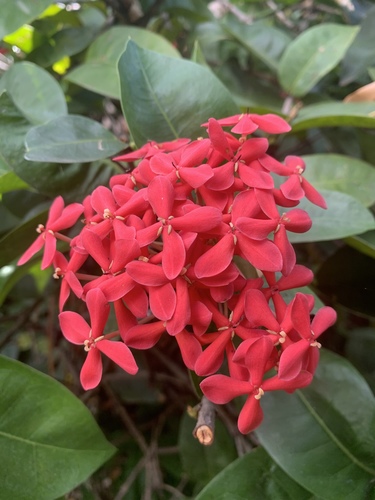
Jungle flame
Ixora coccinea
A burst of tropical fire for your backyard, the Jungle Flame is more than just a beautiful shrub—it's a vibrant nectar hub that draws in the neighborhood's most colorful butterflies and birds.
Quick Identification
Size
Typically 4-6 feet (1.2-1.8 meters) in height and spread, but can reach 12 feet (3.6 meters) in wild conditions.
Colors
Brilliant scarlet-red, orange, or yellow flowers in dense clusters; deep glossy green leathery foliage.
Key Features
- Dense, rounded clusters (corymbs) of 20-50 small flowers
- Star-shaped blossoms with four pointed petals and long floral tubes
- Glossy, dark green, opposite-facing leathery leaves
- Woody, multi-stemmed evergreen growth habit
When You’ll See Them
Loading activity data...
Behavior
The Jungle Flame is a sun-loving powerhouse that serves as a cornerstone of tropical and subtropical gardens. While it doesn't move like the wildlife it attracts, it is highly reactive to its environment; in full sun, it produces a profusion of blooms that act as a primary nectar station for various insects and birds. It is a slow-to-moderate grower that maintains a neat, rounded shape even without heavy pruning, though it responds well to shaping.
For the backyard observer, the real "behavior" to watch is the interaction between the plant and its visitors. The long, tubular shape of the flowers makes them specifically adapted for long-tongued pollinators. In urban environments, it is often used as a hedge or foundation plant, providing essential cover for small reptiles and nesting sites for small garden birds during the peak of summer.
EverydayEarth exclusive
Camera Tips
When setting up a trail camera or AI-powered wildlife camera to monitor a Jungle Flame, the focus should be as much on the "visitors" as the plant itself. Position your camera at eye level with the largest flower clusters, typically 3 to 4 feet off the ground. If your camera has a macro or close-focus setting, use it; the intricate structure of the tiny star-shaped flowers provides a stunning backdrop for any visiting butterflies or hummingbirds.
Because the Jungle Flame is a favorite of the Large Orange Sulphur and Zebra Longwing butterflies, set your camera to a high-speed trigger or video mode. These pollinators move quickly between the nectar tubes. To get the best color saturation from the fiery red blooms, angle your camera so the sun is behind it (front-lighting the plant) during the morning hours. Avoid deep shade, as the camera's sensor may struggle with the high contrast between the dark glossy leaves and the bright flowers.
If you are interested in time-lapse photography, the Jungle Flame is an excellent subject. A single cluster can take several days to fully open. Set your camera to take a photo every 30 minutes over a week to capture the "fire" slowly spreading across the bush. During the rainy season, ensure your lens is clear; the waxy leaves of the Ixora often splash water upward, which can blur your shots.
Similar Species
Species that look similar or are commonly confused with Jungle flame.
Chinese Ixora
Features smaller, more rounded leaves and flower clusters that are often pink or light orange rather than scarlet.
Egyptian Starcluster
A smaller, non-woody plant with hairy leaves; the flowers have five petals instead of the Ixora's four.
Scarlet Firebush
Has more elongated, trumpet-shaped orange-red flowers and softer, non-glossy foliage.
Frequently Asked Questions
Record Jungle flame at your habitat
Connect a camera to start building your own species record — AI identifies every visitor automatically.