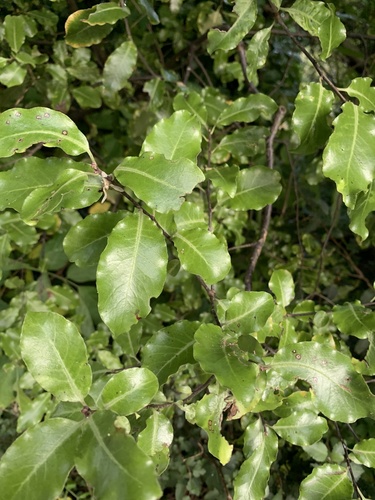
Kōhūhū
Pittosporum tenuifolium
With its shimmering wavy leaves and striking black stems, Kōhūhū is the 'black matipo' of New Zealand. This elegant evergreen hides a secret: tiny chocolate-colored flowers that perfume the night air.
Quick Identification
Size
A small tree or large shrub reaching 10 m (33 ft) in height with a spread of 2-4 m (6-13 ft).
Colors
Pale green to silvery-green leaves with a glossy finish; dark purple to almost black stems and twigs; tiny reddish-purple to chocolate-colored flowers.
Key Features
- Wavy-edged (undulate) oval leaves
- Distinctive black or very dark brown twigs and stems
- Small, five-petaled dark purple flowers
- Pyramidal growth habit that rounds out with age
When You’ll See Them
Geographic range
Where Does the Kōhūhū Live?
Kōhūhū is an endemic treasure of New Zealand, found naturally throughout the North and South Islands except for the most mountainous regions. It thrives in coastal and lowland environments, stretching from the tip of the North Island down to the southern reaches of Westland and Canterbury. Beyond its native shores, it has become a staple in temperate gardens worldwide, particularly in the United Kingdom and coastal North America, where its ornamental foliage is highly prized.
Basemap © OpenStreetMap contributors
Behavior
Kōhūhū is a hardy and fast-growing evergreen tree that plays a vital role as a pioneer species in its native New Zealand. It is often one of the first trees to colonize cleared land, providing essential shelter for slower-growing forest giants. While it appears as a quiet, shimmering presence during the day, it undergoes a transformation at night when its small, dark flowers release a heavy, honey-like fragrance to attract nocturnal pollinators.
In garden settings, Kōhūhū is highly social in an ecological sense, often forming dense hedges that provide high-quality nesting sites and shelter for local bird populations. Its flexible branches are wind-resistant, making it a stable anchor in coastal or exposed backyard environments. For humans, it is a low-maintenance favorite, though its shallow root system means it prefers consistent moisture rather than extreme drought.
EverydayEarth exclusive
Camera Tips
To capture the best of Kōhūhū on your backyard camera, focus on the 'hidden' life of the tree. While the plant itself is stationary, its night-scented flowers attract a variety of nocturnal insects, specifically moths. Position your camera about 1-2 meters away from a flowering branch during the late spring or early summer. Use a macro or close-up setting if available, and ensure your infrared (IR) night vision is optimized to catch the subtle movements of pollinators around the dark purple blooms.
Because of its dense, wavy foliage, Kōhūhū is a favorite 'apartment complex' for small birds. Place your camera at a mid-canopy height (roughly 1.5 to 2 meters) and angle it toward an opening in the branches. This is the best way to record birds like Tui, Silvereye, or Fantails as they dart in and out for shelter or to hunt for insects hiding among the leaves. If you are using an AI-powered camera, the movement of the shimmering leaves in the wind can sometimes trigger false positives; try to shield the camera from direct wind or adjust the sensitivity settings.
For a long-term project, Kōhūhū is an excellent candidate for time-lapse photography. Set your camera to take one photo every day at the same time to document the 'flush' of new pale green growth in the spring against the older, darker foliage. You can also track the development of the woody seed capsules, which split open to reveal sticky black seeds that are often dispersed by birds—a fantastic sequence to capture over several months.
Similar Species
Species that look similar or are commonly confused with Kōhūhū.
Frequently Asked Questions
Record Kōhūhū at your habitat
Connect a camera to start building your own species record — AI identifies every visitor automatically.