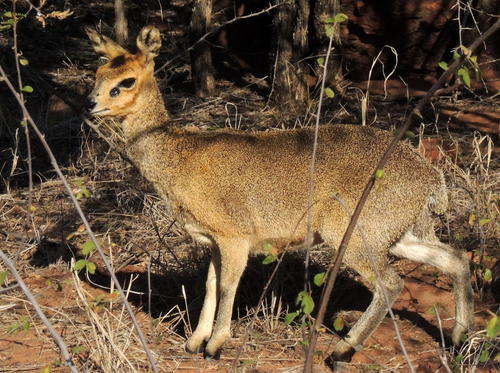
Klipspringer
Oreotragus oreotragus
Meet the 'rock jumper' of the African savannah, an agile acrobat that spends its life on the tips of its toes. The klipspringer is a master of the mountains, blending seamlessly into the stony outcrops of Eastern and Southern Africa.
Quick Identification
Size
Shoulder height 43–60 cm (17–24 in); weight 8–18 kg (18–40 lbs)
Colors
Speckled yellowish-gray, olive, or reddish-brown coat with a 'salt and pepper' appearance; white underparts, chin, and around the eyes.
Key Features
- Walking on 'tiptoes' with unique cylindrical hooves
- Thick, coarse coat with hollow, brittle hairs
- Short, straight spiky horns (males only, 7.5–9 cm)
- Prominent black preorbital scent glands near the eyes
When You’ll See Them
Geographic range
Where Does the Klipspringer Live?
Native to the African continent, the klipspringer thrives in fragmented populations across Eastern and Southern Africa. Their range extends from the rugged highlands of Ethiopia and Eritrea, down through the Great Rift Valley into Kenya and Tanzania, and reaches its highest densities in the rocky koppies of South Africa, Namibia, and Zimbabwe. Because they are strictly tied to rocky terrain, their distribution is naturally patchy, occurring wherever 'islands' of stone emerge from the surrounding savannah or desert.
Basemap © OpenStreetMap contributors
Behavior
Klipspringers are remarkable for their specialized movement. They are the only antelopes that walk on the tips of their hooves, which have a rubbery center to provide incredible grip on smooth, vertical rock surfaces. They are typically found in monogamous pairs that occupy a fixed territory for life. This social bond is exceptionally strong; the pair rarely stays more than a few meters apart, with one partner acting as a sentinel while the other feeds.
When threatened, they emit a loud, piercing whistle that serves as an alarm to their mate and other nearby wildlife. Despite being shy, they are often seen standing motionless on high rocky perches, relying on their incredible camouflage to blend into the stones. They are highly territorial and use their large preorbital glands to mark twigs and rocks with a thick, black secretion to define their boundaries.
EverydayEarth exclusive
Camera Tips
To successfully capture a klipspringer on camera, you must focus entirely on their vertical world. These antelopes are almost never found more than a few yards away from 'koppies' or rocky outcrops. Scout for 'middens'—communal dung heaps—which these animals use repeatedly to mark their territory. A camera positioned 15–20 feet away from a midden, angled slightly upward, is one of the most effective ways to capture the resident pair during their daily marking routine.
Mounting height is a critical factor for success. Since klipspringers are relatively small, your camera should be secured approximately 18 to 24 inches off the ground. If you are placing the camera on a ledge or rocky shelf, ensure it is anchored firmly, as wind at higher elevations can cause false triggers or shift the camera's field of view. Because they are most active during the twilight hours of dawn and dusk, use a camera with a high-quality CMOS sensor and fast trigger speed to avoid blurred shots in low light.
While they are browsers and typically ignore grain-based baits, klipspringers are highly attracted to mineral deposits. In private backyard settings or reserves where it is legal, placing a mineral salt block near a prominent lookout rock can encourage them to pose for the camera. Look for 'scent-marking twigs'—small branches at klipspringer eye-level that look dark and waxy from their preorbital gland secretions; focusing your camera on these specific points will often result in excellent close-up 'headshots' of the animal in action.
Similar Species
Species that look similar or are commonly confused with Klipspringer.
Frequently Asked Questions
Record Klipspringer at your habitat
Connect a camera to start building your own species record — AI identifies every visitor automatically.