Kānuka
Kunzea ericoides
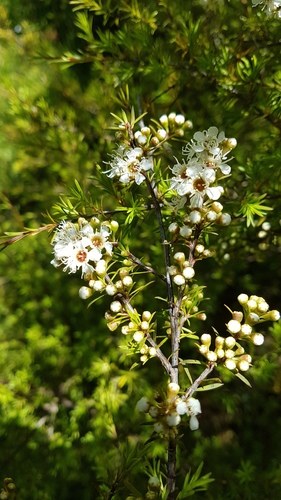
The Kānuka is the graceful architect of the New Zealand bush, draped in delicate white blossoms that hum with life. Known for its soft touch and enduring strength, it is a vital sanctuary for the country’s most iconic birds and insects.
Quick Identification
Size
Grows up to 30 meters (100 feet) tall with a trunk diameter of up to 60 centimeters (2 feet).
Colors
Bright green needle-like foliage; white or occasionally pale pink flowers; gray-brown papery bark.
Key Features
- Soft, narrow leaves that are not prickly to the touch
- White 5-petaled flowers with long, protruding stamens
- Rough, stringy bark that peels in long, narrow strips
- Tall, spreading canopy often forming dense stands.
When You’ll See Them
Behavior
Kānuka is a foundational species in New Zealand's ecosystem, often acting as a 'nurse plant.' It grows rapidly to provide shelter and shade, creating a protected environment where slower-growing canopy trees can establish themselves. Unlike many other forest giants, Kānuka is relatively long-lived for a colonizing species, with some individuals reaching over 150 years of age.
While it may appear as a simple backdrop in the garden, Kānuka is a hive of social activity. During its summer flowering peak, it produces copious amounts of nectar that attract a vast array of native biodiversity. It interacts closely with humans as a preferred source for high-quality honey production and is historically valued for its incredibly hard, durable wood, which earned it the nickname 'ironwood' among early settlers.
EverydayEarth exclusive
Camera Tips
Capturing the beauty of Kānuka requires a shift in strategy from traditional wildlife tracking. To document the tree's life cycle, set your camera to time-lapse mode during the late spring. Position the lens to frame a cluster of buds; by taking one photo every hour, you can create a stunning sequence of the 'white-out' effect when the tree becomes smothered in blossoms. This is the best way to visualize the transition from green shrub to a snow-like canopy.
For those interested in the wildlife that visits the Kānuka, place your camera on a sturdy nearby branch or a tripod aimed at a flowering limb about 2 to 3 meters off the ground. Kānuka is a magnet for native birds like the Tūī and Korimako (Bellbird). To avoid 'false triggers' caused by the Kānuka’s thin, spindly branches swaying in the wind, lower your camera’s PIR (motion) sensitivity or use a 'Hybrid' mode that records on a timer during peak daylight hours when birds are most active.
Don't just look at the flowers; the trunk is a microcosm of its own. The deeply furrowed, peeling bark is a favorite hiding spot for bark geckos and various native beetles. Mount a camera vertically against the trunk using a macro lens attachment if possible. This setup is particularly effective at night with a low-glow infrared flash to catch nocturnal geckos emerging from the bark crevices to hunt insects attracted to the tree.
In a backyard setting, Kānuka provides excellent natural 'cover' for your camera. You can camouflage your device within the dense foliage to monitor ground-dwelling visitors like Pīwakawaka (Fantails) that flit around the lower branches to catch insects disturbed by the tree's movement. Ensure the lens is clear of immediate leaves, as even a small leaf close to the IR sensor can cause overexposure during night shots.
Frequently Asked Questions
Record Kānuka at your habitat
Connect a camera to start building your own species record — AI identifies every visitor automatically.