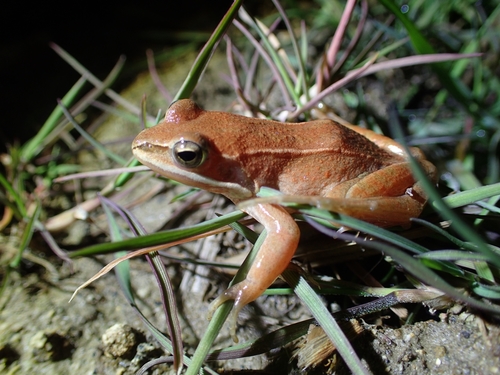
Korean Brown Frog
Rana coreana
The ultimate early riser, the Korean Brown Frog emerges when the ground is still thawing. This slender, masked acrobat is a master of the garden undergrowth and a sign that spring has truly arrived.
Quick Identification
Size
3.5 to 5.2 cm (1.4 to 2.0 inches) in length; typically weighs 5-15 grams
Colors
Shades of reddish-brown, tan, or yellowish-brown; features a prominent dark brown 'mask' from the snout to the shoulder; creamy white to yellowish belly often with faint mottling.
Key Features
- Pointed, aerodynamic snout profile
- Distinct dark 'robber mask' behind the eye
- Parallel dorsolateral folds running down the back
- Slender, long hind legs for jumping
When You’ll See Them
Behavior
The Korean Brown Frog is a remarkably hardy amphibian, often earning the title of the first herald of spring. In the Korean Peninsula, it is famous for emerging from hibernation while ice is still melting on the ponds, sometimes even migrating across patches of snow to reach breeding grounds. They are far more cold-tolerant than most other frogs in their range, which gives them a head start on the season.
Outside of the frantic early-spring breeding season, these frogs are relatively quiet and terrestrial. They spend their days tucked under leaf litter or within the cool shade of garden vegetation to keep their skin moist. While they are generally solitary, you might find several congregating in a single damp backyard corner if the hunting for small insects is particularly good.
EverydayEarth exclusive
Camera Tips
To capture high-quality footage of the Korean Brown Frog, your camera needs to be at eye-level with the subject—which means placing it just 2 to 5 inches off the ground. Because these frogs are small and their body temperature often matches the ambient air, standard PIR motion sensors can sometimes miss them. For the best results, use a camera with a high-sensitivity setting or set a short-interval time-lapse (every 30-60 seconds) during the dawn and dusk hours.
Placement is everything. Look for 'corridors' where the soil remains damp, such as near a leaky outdoor faucet, a garden pond edge, or along a line of decorative stones. If you have a small water feature, aim the camera at a flat landing stone or a shallow 'beach' area. These frogs aren't attracted to traditional bait, but you can lure them by creating a 'toad house'—an overturned ceramic pot with a small entrance—which provides the damp, dark shelter they crave during the day.
During the peak breeding season in early spring, the frogs are much bolder and more active during daylight. This is the best time to capture their unique 'clucking' vocalizations. If your camera has an adjustable focal length, set it to its closest possible setting (macro focus) to ensure the frog's fine skin textures and 'mask' are sharp. Wide-angle lenses are great for context, but a closer crop will help the AI identify this specific species.
Finally, consider the background. Because these frogs are masters of camouflage against brown leaves, placing your camera near a patch of green moss or a lighter-colored stone can help the frog stand out in your captures. Keep the area immediately in front of the lens clear of tall grass, as wind-blown blades will cause hundreds of 'false' triggers and drain your battery before the frog even arrives.
Similar Species
Species that look similar or are commonly confused with Korean Brown Frog.
Frequently Asked Questions
Record Korean Brown Frog at your habitat
Connect a camera to start building your own species record — AI identifies every visitor automatically.