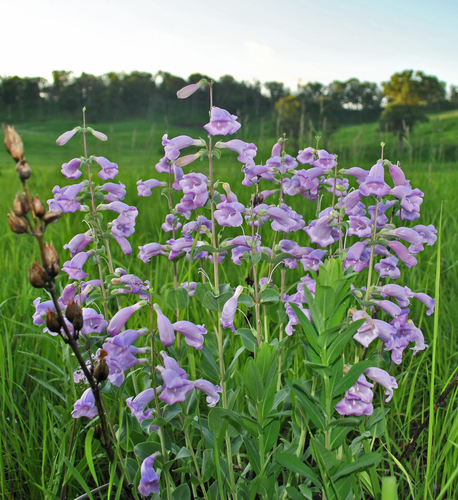
large-flowered beardtongue
Penstemon grandiflorus
The crown jewel of the prairie, the large-flowered beardtongue commands attention with its towering spikes of oversized lavender blooms and unique waxy foliage.
Quick Identification
Size
Reaches heights of 24-48 inches (60-120 cm) with flowers measuring 2 inches (5 cm) in length
Colors
Soft lavender to shell-pink blossoms with waxy, blue-gray or glaucous foliage
Key Features
- Extraordinarily large, bell-shaped lavender flowers
- Thick, rounded, waxy blue-green leaves that clasp the stem
- Tall, rigid, unbranched flowering stalks
- Prominent sterile stamen (the 'beard') inside the flower throat
When You’ll See Them
Behavior
Large-flowered beardtongue is a short-lived perennial that operates with a 'live fast, die young' strategy. In its first year, it typically remains a modest basal rosette of waxy leaves, hugging the ground to establish a deep taproot. By its second or third year, it sends up a majestic, skyward-reaching spike crowded with oversized blossoms that look almost tropical against the backdrop of the North American prairie.
This species is a master of pollinator interaction. Its flowers are specifically engineered to accommodate large-bodied bees, particularly bumblebees, which must muscle their way into the bloom to reach the nectar reward. It also serves as a vital early-summer fuel station for ruby-throated hummingbirds. Because it is a short-lived species, it relies heavily on self-seeding, often appearing to 'migrate' around a garden or field over several seasons as older plants die and new seedlings emerge in nearby sunny spots.
EverydayEarth exclusive
Camera Tips
To capture the majesty of the large-flowered beardtongue, position your camera at a low 'worm’s-eye' view, roughly 12 to 18 inches off the ground. This angle emphasizes the height of the flower spikes against the sky and allows you to look directly into the open 'mouths' of the downward-curving blossoms. If you are using an AI-powered camera to capture wildlife, aim the lens at the mid-section of the stalk where the most flowers are open; this is the 'strike zone' for visiting hummingbirds and bumblebees.
Because these plants thrive in full sun, light management is key. The waxy, glaucous leaves have a beautiful matte texture that can look washed out in harsh midday light. For the most dramatic shots, set your camera to capture images during the 'Golden Hour'—shortly after sunrise or before sunset. The low-angled light will catch the translucent edges of the lavender petals and create a glowing effect that highlights the plant's structural elegance.
For those interested in the 'behavior' of the plant, utilize a time-lapse setting. Large-flowered beardtongue blooms sequentially from the bottom of the stalk upward. Setting a camera to take one photo every 30 minutes over the course of a week will reveal the stunning 'laddering' effect of the blossoms opening. If you are targeting pollinators, ensure your camera has a fast trigger speed (0.2 seconds or less), as bumblebees tend to spend only a few seconds inside each flower before darting to the next.
Placement in the garden matters. Since this plant prefers sandy, well-drained spots, your camera should be mounted on a stable stake rather than a tripod, as sandy soil can shift. Avoid placing the camera too close—maintain a minimum focus distance of about 2 feet unless you have a macro lens capability. This ensures that the swaying of the tall stalks in a prairie breeze won't result in motion-blurred images. If the area is particularly windy, you can discreetly stake the flower stalk to a thin bamboo rod to keep it steady for the camera.
Similar Species
Species that look similar or are commonly confused with large-flowered beardtongue.
Frequently Asked Questions
Record large-flowered beardtongue at your habitat
Connect a camera to start building your own species record — AI identifies every visitor automatically.