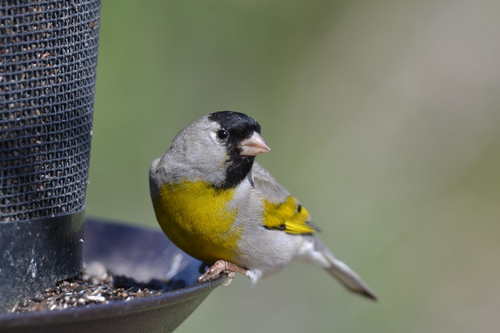
Lawrence's Goldfinch
Spinus lawrencei
A rare gem of the American West, Lawrence's Goldfinch is a nomadic beauty known for its striking black mask and soft gray plumage. Discover how to spot this elusive visitor in your own oak woodlands or backyard garden.
Quick Identification
Size
Length: 10-12 cm (4-4.7 in); Wingspan: 21 cm (8.3 in); Weight: 9-14 g (0.3-0.5 oz)
Colors
Soft gray body; males have a black forehead, face, and chin with yellow breast and wing patches; females are duller gray-brown without the black mask.
Key Features
- Black face mask and chin on males
- Distinctive yellow patches on wings and chest
- Overall soft pearly-gray plumage
- Short, conical pinkish bill
When You’ll See Them
Geographic range
Where Does the Lawrence's Goldfinch Live?
This elusive songbird is native to the North American West, primarily centered in the Mediterranean climates of California and northern Baja California. While its breeding core is restricted to these regions, the species is famous for its erratic winter wanderings into the desert Southwest of the United States, including Arizona and New Mexico, as well as northern Mexican states like Sonora and Chihuahua. Because of its nomadic lifestyle, a backyard that hosts them one spring might not see them again for several years, making every sighting a special event for birders.
Basemap © OpenStreetMap contributors
Behavior
Lawrence's Goldfinches are among the most enigmatic songbirds in North America due to their highly nomadic and erratic nature. Unlike many species that return to the same breeding grounds year after year, these goldfinches may be abundant in a specific oak woodland one spring and entirely absent the next. They are deeply social birds, often seen in small flocks that move with a characteristic undulating flight pattern, frequently calling to one another with a high-pitched, musical 'tinkling' sound.
When foraging, they are agile and acrobatic, often hanging upside down from seed heads or moving through the outer canopy of oak trees. They are particularly fond of water and are known to visit birdbaths or natural seeps in groups. Interestingly, they are accomplished mimics; a listening observer might hear them incorporating the calls of other local birds, like kingbirds or scrub-jays, into their complex, rambling songs.
EverydayEarth exclusive
Camera Tips
To capture high-quality footage of the Lawrence's Goldfinch, your primary focus should be on water. Because they inhabit arid or semi-arid environments, they are highly attracted to dripping water features or low-profile birdbaths. Position your AI camera at a low angle, roughly 6 to 12 inches above the water level, and try to frame the shot so the bird is backlit by morning sun to highlight the translucence of their yellow wing feathers.
While they are less common at traditional feeders than American Goldfinches, you can increase your chances by offering Nyjer (thistle) or fine-hulled sunflower chips. Place your camera on a mount facing a specialized finch feeder, but ensure there are natural 'staging' branches nearby. These birds prefer to land on a branch and scan the area before dropping down to eat; a camera aimed at a well-placed oak twig 2 feet from the feeder will often yield more natural and aesthetic shots than a camera pointed directly at the plastic feeder port.
Set your camera to a high-sensitivity motion trigger with a short reset time. Goldfinches are notoriously 'twitchy' and may only stay at a water source for a few seconds. If your camera supports it, use a burst photo mode or a high-frame-rate video setting (60fps) to capture the rapid movement of their wings. Because they are nomadic, keep your equipment active and ready during the peak spring migration months of March and April, even if you haven't seen them in your yard for years.
Similar Species
Species that look similar or are commonly confused with Lawrence's Goldfinch.
Frequently Asked Questions
Record Lawrence's Goldfinch at your habitat
Connect a camera to start building your own species record — AI identifies every visitor automatically.