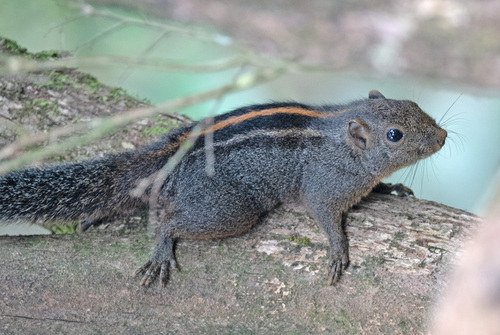
Layard's Palm Squirrel
Funambulus layardi
Known as the 'Flame-striped jungle squirrel,' this vibrant endemic species is a master of the Sri Lankan canopy. With its brilliant orange stripes and shy nature, it is one of the island's most beautiful and sought-after rodents.
Quick Identification
Size
Head-and-body length of 13–17 cm (5–7 in) with a tail of 12–16 cm (5–6 in); weight ranges from 150–220g (5.3–7.8 oz).
Colors
Deep blackish-brown upper body with three prominent orange-yellow longitudinal stripes; the belly is a vivid reddish-orange or flame color.
Key Features
- Three distinct orange-yellow stripes on a dark back
- Bright reddish-orange 'flame' belly
- Bushy tail with mixed black and orange hairs
- Small, rounded ears and dark, inquisitive eyes
When You’ll See Them
Geographic range
Where Does the Layard's Palm Squirrel Live?
This striking squirrel is an endemic treasure of the island of Sri Lanka, found nowhere else in the world. It is restricted to the humid wet zone regions, with its core populations residing in the Central Highlands and the southwestern rainforests like Sinharaja. While historically reported in the southern tip of India, those sightings are now widely considered to be misidentified juvenile Dusky Striped Squirrels.
Basemap © OpenStreetMap contributors
Behavior
The Layard's Palm Squirrel is a shy and predominantly arboreal species, spending the majority of its life in the mid-to-upper canopy of dense forests. Unlike the common Indian Palm Squirrel often found in urban parks, this species is much more reclusive and rarely descends to the ground. It moves with great agility along branches, using its bushy tail for balance as it leaps between trees in search of food.
Socially, they are often seen alone or in small family groups. They are highly vocal, possessing a repertoire of bird-like chirps and whistles that are frequently mistaken for forest birds. These calls are essential for territorial defense and alerting others to the presence of predators like crested serpent eagles or leopards. While they generally avoid human contact, they may visit gardens that border forest reserves if there is ample tree cover and quiet surroundings.
EverydayEarth exclusive
Camera Tips
To successfully capture the Layard's Palm Squirrel on camera, elevation is your best friend. This species is rarely seen on the forest floor, so avoid ground-level sets. Mount your AI-powered camera on a sturdy tree trunk or a thick horizontal branch about 6 to 10 feet above the ground. Position the lens to look along the length of a 'travel branch'—a limb that connects two trees—as squirrels often use these as highways through the canopy.
While they are naturally wary, you can encourage them to pause in front of your camera using a lure. Fresh coconut pieces or native fruits like wild mango are highly effective. Secure the bait to the branch so the squirrel has to stay in place to eat it, giving your camera enough time to trigger and focus. Because these squirrels have dark fur, they can be difficult to see in deep forest shade; try to find a spot where dappled morning light hits the branch to highlight their orange stripes.
Use a high-speed trigger setting if available, as their movements are incredibly fast. Setting your camera to record short 10-20 second video clips is often more rewarding than still photos, as it allows you to capture their unique tail-flicking behavior and bird-like vocalizations. If you live near a forest edge in the Sri Lankan highlands, keep your camera active during the early morning hours when their activity peaks.
Frequently Asked Questions
Record Layard's Palm Squirrel at your habitat
Connect a camera to start building your own species record — AI identifies every visitor automatically.