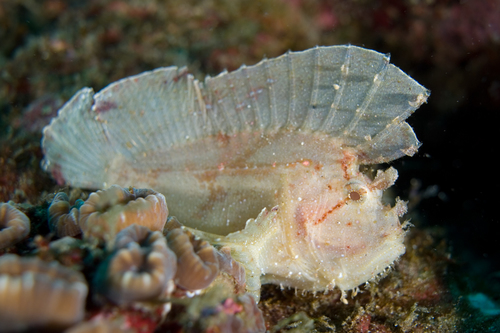
Leaf Scorpionfish
Taenianotus triacanthus
A master of underwater disguise, the Leaf Scorpionfish hides in plain sight by mimicking a piece of drifting debris. This colorful, paper-thin predator is one of the most fascinating residents of the Indo-Pacific reefs.
Quick Identification
Size
Small and compressed, typically reaching 10 cm (4 inches) in length.
Colors
Highly variable; can appear in shades of yellow, pink, red, brown, black, or white, often changing color after molting to match surrounding sponges or algae.
Key Features
- Extremely thin, laterally compressed body resembling a leaf
- High, sail-like dorsal fin starting just behind the eyes
- Characteristic side-to-side rocking motion that mimics floating debris
- Regularly sheds its skin (molting) to remove algae and parasites
When You’ll See Them
Geographic range
Where Does the Leaf Scorpionfish Live?
The Leaf Scorpionfish is a quintessential Indo-Pacific species, boasting a massive native range that stretches from the eastern coast of Africa and the Red Sea across the Indian Ocean to the tropical reaches of the Pacific. It is commonly found in the waters of Australia, Indonesia, and the Philippines, and extends as far north as southern Japan and as far east as the Hawaiian Islands and the Galapagos. While they are restricted to marine environments, they are a staple sighting for reef explorers across the tropical belt of the Southern Hemisphere.
Basemap © OpenStreetMap contributors
Behavior
The Leaf Scorpionfish is a master of mimicry and one of the most sedentary inhabitants of the coral reef. To the untrained eye, this fish looks exactly like a piece of dead leaf or seaweed drifting in the current. It enhances this illusion by swaying gently from side to side, a rhythmic rocking motion that mimics the natural movement of water-borne debris. This behavior allows it to remain undetected by both the small crustaceans it hunts and the larger predators that might otherwise make a meal of it.
Unlike most fish that swim actively to find mates or food, the Leaf Scorpionfish rarely moves more than a few meters from its chosen spot. They are known to remain in the same crevice or on the same sponge for weeks or even months at a time. They are generally solitary creatures and are remarkably docile around humans, relying entirely on their camouflage for defense. However, they do possess venomous spines on their fins which serve as a last resort against persistent threats.
EverydayEarth exclusive
Camera Tips
Capturing the Leaf Scorpionfish on an underwater AI-powered camera requires a specific focus on macro-level detail. Because these fish are so still, they are perfect subjects for stationary camera setups, but their camouflage makes them difficult for standard motion sensors to trigger. If your camera system uses visual AI, ensure it is trained to recognize the distinct 'sail-like' dorsal fin profile, as this is the most identifiable feature when the fish is viewed from the side.
Placement is critical; look for 'cleaning stations' or sheltered reef ledges where sponges are abundant. These fish love to perch on top of or tucked inside sponges that match their current color. Position the camera at a slight upward angle to capture the paper-thin silhouette against the water column, which helps emphasize their unique morphology. Because they stay in one place for days, you can afford to set a slower trigger speed, but ensure your image quality is high enough to resolve the tiny skin flaps that look like algae.
For lighting, use a diffused wide-angle video light rather than a harsh strobe. This will help the AI-powered sensor maintain color accuracy, which is vital since these fish come in every color from bright magenta to dull brown. If you are using a time-lapse setting, a 10-second interval is ideal; it’s long enough to capture their slow swaying movement but short enough to catch the lightning-fast strike when they inhale a passing shrimp, a movement that lasts only a fraction of a second.
Similar Species
Species that look similar or are commonly confused with Leaf Scorpionfish.
Frequently Asked Questions
Record Leaf Scorpionfish at your habitat
Connect a camera to start building your own species record — AI identifies every visitor automatically.