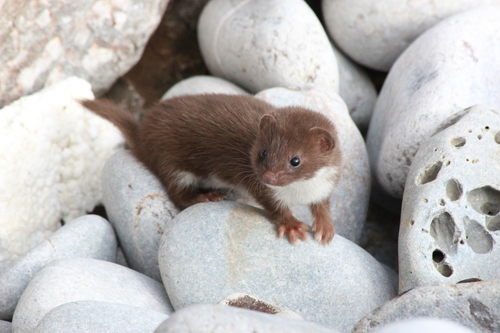
Least Weasel
Mustela nivalis
The least weasel is the world’s smallest carnivore—a tiny, fearless hunter capable of squeezing through a wedding ring. Though rarely seen, this high-energy predator is a master of the backyard undergrowth, patrolling woodpiles and stone walls with relentless intensity.
Quick Identification
Size
Length: 11–26 cm (4.5–10 in); Tail: 1–6 cm (0.5–2.5 in); Weight: 25–250 g (1–9 oz)
Colors
Reddish-brown upper parts with a white underbelly; in northern regions, the coat turns entirely white during winter.
Key Features
- Smallest carnivorous mammal in the world
- Short tail that lacks a black tip
- Long, slender, tube-like body
- Pointed face with large black eyes and rounded ears
When You’ll See Them
Geographic range
Where Does the Least Weasel Live?
The least weasel is native to the vast temperate and arctic regions of the Northern Hemisphere, spanning across North America, Europe, Northern Africa, and Asia. It is widely distributed from the United Kingdom across the Russian Steppe to Japan, and from Alaska across most of the northern and central United States. Beyond its native range, it has been introduced to several islands including New Zealand, where it is considered an invasive species.
Basemap © OpenStreetMap contributors
Behavior
The least weasel is a high-octane predator that lives life at a frantic pace. Because of its incredibly high metabolic rate, it must consume up to half of its body weight every single day just to survive. This drives a near-constant hunting cycle, where the weasel is active for short bursts throughout the day and night, followed by brief periods of deep sleep. They are solitary and highly territorial, often marking their range with scent to warn off intruders.
Despite their diminutive size, they are remarkably bold and aggressive. They are specialized 'tunnel hunters,' possessing a flexible spine that allows them to follow mice and voles directly into their burrows. When confronted by humans or larger predators, they often emit a shrill shriek and a musk-like odor from their scent glands. They are rarely seen out in the open, preferring to move through tall grass, stone walls, or woodpiles to avoid avian predators.
EverydayEarth exclusive
Camera Tips
Capturing a least weasel on camera requires precision because of their incredible speed and small size. The most effective placement is just 2 to 4 inches off the ground. Position your camera along 'corridors' like the base of a stone wall, a fallen log, or the edge of a woodpile. Since they are so small, a camera with a short focal length or a 'macro' capability is ideal to prevent the subject from appearing as a brown blur.
To stop a weasel in its tracks for a clear photo, use an 'attractant station.' A small wooden tunnel or a length of PVC pipe placed in front of the camera can entice them to investigate. You can also use a strong-smelling lure; canned sardines in oil or a cotton ball soaked in rabbit bedding scent are highly effective. Place the bait inside a small cage or a perforated container so the weasel spends time trying to reach it rather than simply running off with it.
Because least weasels move like lightning, camera settings are critical. Set your camera to 'Burst Mode' or 'Photo + Video' with a very high trigger speed (0.2s or faster). Use a high shutter speed if your camera allows it to reduce motion blur. If you are recording video, 60fps is much better than 30fps for capturing their fluid, serpentine movements. Make sure the PIR sensitivity is set to 'High' so the camera triggers for such a small heat signature.
Seasonal timing can also work in your favor. In northern latitudes, least weasels turn white in winter to blend in with the snow. During this time, placing your camera against a dark background, like the entrance to a woodpile or a patch of bare earth under a cedar tree, will make the white weasel pop in the frame. Conversely, in summer, a patch of light-colored sand or gravel can help highlight their dark brown summer coats.
Similar Species
Species that look similar or are commonly confused with Least Weasel.
Frequently Asked Questions
Record Least Weasel at your habitat
Connect a camera to start building your own species record — AI identifies every visitor automatically.