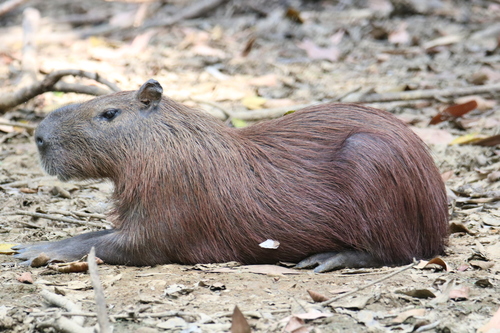
Lesser Capybara
Hydrochoerus isthmius
Meet the world's second-largest rodent, a shy and social semi-aquatic specialist of the Neotropics. Perfectly adapted for a life between land and water, the Lesser Capybara is a master of the marshlands.
Quick Identification
Size
Length: 80–100 cm (31–39 in); Weight: 25–45 kg (55–100 lbs)
Colors
Uniform reddish-brown to dark gray-brown fur; skin is visible through sparse hair; muzzle is typically darker than the body
Key Features
- Stocky, barrel-shaped body with no tail
- Webbed feet for efficient swimming
- High-set eyes, ears, and nostrils for remaining partially submerged
- Smaller and darker than the common capybara
When You’ll See Them
Geographic range
Where Does the Lesser Capybara Live?
The Lesser Capybara is native to the tropical regions of the northwestern corner of South America and the southernmost reaches of Central America. Its core distribution is centered in Panama, northern Colombia, and northwestern Venezuela, particularly along major river basins and coastal wetlands. Unlike many other rodents, it is rarely found far from a reliable water source, making its range quite localized to riparian corridors and marshy lowlands.
Basemap © OpenStreetMap contributors
Behavior
The Lesser Capybara is a highly social creature, though it typically lives in smaller family groups compared to its larger relative, the common capybara. These groups usually consist of a dominant male, several females, and their offspring. They are semi-aquatic experts, spending the hottest parts of the day submerged in water or wallowing in mud to regulate their body temperature and protect their sensitive skin from the tropical sun. When resting, they often stay close to the water's edge, ready to dive in at the first sign of a predator.
Naturally crepuscular, they are most active during the cooler hours of dawn and dusk. However, in areas where they are frequently disturbed by human activity or hunting, they are known to adopt a strictly nocturnal lifestyle to stay safe. They communicate through a complex range of sounds, including low-frequency grunts, whistles, and even bird-like chirps to maintain contact with the group or sound an alarm. On land, they move with a somewhat awkward waddle, but in the water, they are graceful and powerful swimmers.
EverydayEarth exclusive
Camera Tips
To capture high-quality footage of the Lesser Capybara, focus your camera placement on the 'transition zones' between land and water. Look for muddy paths or flattened grass along riverbanks and pond edges where the rodents enter and exit the water. Because they have a low center of gravity, mount your camera approximately 18 to 24 inches from the ground. Angle the lens slightly downward if the camera is on a slope, or keep it level if placed on a flat grazing patch near the water.
Since these animals are often shy and shift to nocturnal habits in populated areas, utilizing a camera with high-quality infrared (IR) night vision is essential. Avoid cameras with a visible red glow if possible, as the 'no-glow' black LEDs are less likely to spook them. They are particularly wary of human scent; use gloves when handling your equipment and try to minimize the frequency of your visits to the camera site. Placing the camera near a favorite 'wallow'—a muddy depression they use for cooling off—can provide some of the most engaging behavioral footage.
While capybaras are not easily lured with traditional food baits like peanut butter, they are highly attracted to fresh, lush green grass. If your camera is in a backyard setting, keeping a small patch of grass well-watered and trimmed can act as a natural attractant. Set your camera to take short video clips (15-30 seconds) rather than just stills; their slow grazing movements and social interactions, like grooming or vocalizing, are much better captured in motion. Ensure your trigger speed is fast, as they can dive into the water with surprising speed if they are startled.
Frequently Asked Questions
Record Lesser Capybara at your habitat
Connect a camera to start building your own species record — AI identifies every visitor automatically.