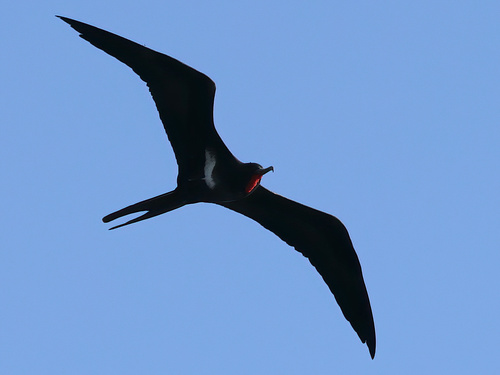
Lesser Frigatebird
Fregata ariel
Often called the 'Man-o'-War' bird, the Lesser Frigatebird is the ultimate pirate of the tropical skies. With a massive wingspan and an iconic red throat pouch, this acrobatic flyer never lets its feathers touch the sea.
Quick Identification
Size
Length of 66–81 cm (26–32 in), wingspan of 155–193 cm (61–76 in), and weight between 625–955 g (1.4–2.1 lb)
Colors
Males are entirely black with white 'axillary spurs' on their sides; females have a white breast and a white collar around the neck; juveniles have rusty-colored heads.
Key Features
- Long, deeply forked 'scissor' tail
- Narrow, pointed wings held in a distinct 'W' shape
- Male features a bright red inflatable gular pouch during breeding
- White patches on the lower abdomen/armpit area
When You’ll See Them
Geographic range
Where Does the Lesser Frigatebird Live?
The Lesser Frigatebird is a wide-ranging mariner of the tropical and subtropical Indian and Pacific Oceans, with core populations spanning from the Seychelles to the coast of northern Australia and throughout Southeast Asia. Interestingly, a small and unique population also exists in the Atlantic, specifically on Trindade Island off the coast of Brazil. Because they are highly pelagic, they are often seen hundreds of miles from land, though they always return to remote, predator-free islands for the breeding season.
Basemap © OpenStreetMap contributors
Behavior
The Lesser Frigatebird is a master of the skies, spending months at a time on the wing without ever touching the water. Because their feathers are not waterproof, they are unable to swim; instead, they use their incredible agility to snatch flying fish or squid from the surface while in flight. They are famous for 'kleptoparasitism,' a behavior where they harass other seabirds like boobies until the victims regurgitate their catch, which the frigatebird then catches in mid-air.
Socially, these birds are highly colonial, nesting in large groups on remote oceanic islands. During the breeding season, males perform a spectacular display by inflating their vibrant red throat pouches into balloon-like shapes to attract passing females. Despite their aggressive feeding habits, they are quite graceful and silent when soaring, often using thermal updrafts to reach great altitudes with minimal effort.
EverydayEarth exclusive
Camera Tips
Capturing the Lesser Frigatebird on camera requires a specialized approach since they rarely land on the ground. If you are in a coastal area, position your AI camera on a high vantage point such as a cliff edge, balcony, or a sturdy pole facing the prevailing winds. These birds love to 'hang' in the wind, using the lift to hover nearly motionless, which provides the perfect opportunity for a clear shot without the motion blur associated with their high-speed dives.
Because of the highly reflective ocean environment, salt spray can quickly cloud your lens. We recommend using an IP67-rated waterproof housing and wiping the lens with a specialized anti-fog and hydrophobic coating once a week. Angle the camera slightly downward (about 10-15 degrees) to avoid direct sun glare from the sky while still capturing the birds as they glide across the horizon or descend toward nesting sites.
If you are near a known breeding colony, set your camera's trigger sensitivity to 'High' and use a rapid-fire or burst mode. The most iconic shot is the male’s inflated red pouch, which is only visible during the breeding season. Since these birds are most active during the brightest parts of the day, ensure your camera has a fast shutter speed capability (at least 1/1000s) to freeze the action of their deeply forked tails and narrow wingtips.
Similar Species
Species that look similar or are commonly confused with Lesser Frigatebird.
Great Frigatebird
Larger in size; males lack the white side patches (spurs) that the Lesser Frigatebird possesses.
Christmas Frigatebird
Critically endangered and larger; females have a distinct white belly but lack the white collar of the Lesser Frigatebird.
Brown Booby
Heavier set with a straight, pointed tail rather than the deeply forked tail of the frigatebird; frequently dives into the water.
Frequently Asked Questions
Record Lesser Frigatebird at your habitat
Connect a camera to start building your own species record — AI identifies every visitor automatically.