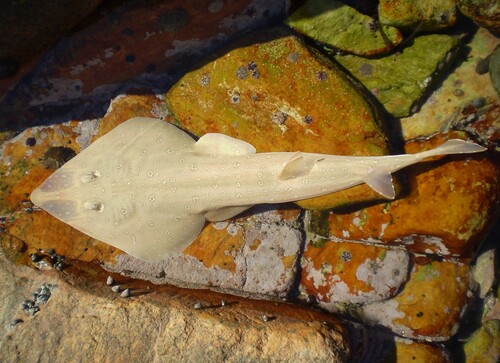
Lesser Guitarfish
Acroteriobatus annulatus
Meet the 'Sandshark' that isn't a shark at all—the Lesser Guitarfish is a beautifully patterned ray that glides through the Southern African surf like a ghost on the seafloor.
Quick Identification
Size
Typically 60–100 cm (2–3.3 ft), reaching a maximum of 140 cm (4.6 ft); weight up to 15 kg (33 lbs)
Colors
Sandy brown to greyish-yellow dorsal surface covered in numerous small, dark-edged rings or spots; white underside
Key Features
- Flattened, disc-shaped forebody with a thick, shark-like tail
- Pointed, wedge-shaped snout
- Distinctive dark 'ocelli' or ring-like markings across the back
- Two large dorsal fins located far back near the tail
When You’ll See Them
Geographic range
Where Does the Lesser Guitarfish Live?
The Lesser Guitarfish is a native resident of the coastal waters of Southern Africa. Its core range extends from central Namibia around the Cape of Good Hope to central KwaZulu-Natal in South Africa. While it is a staple of the Atlantic and Indian Ocean shorelines in this region, it is most commonly encountered in the warm-temperate waters of the Eastern and Western Cape provinces, where it thrives in the sandy-bottomed bays.
Basemap © OpenStreetMap contributors
Behavior
The Lesser Guitarfish is a master of camouflage, often found partially buried in the sand with only its eyes and spiracles exposed. This bottom-dwelling species is remarkably docile and spends much of its day resting in shallow coastal waters. Despite their shark-like appearance, they are technically a type of ray and are completely harmless to humans, lacking the stinging spine found in many of their cousins.
These fish are most active during the rising tide when they move into the surf zone to forage. While they are often solitary, they can be found in high densities in sheltered bays and estuaries, particularly during the summer breeding season. When threatened or disturbed, they use their powerful tails to provide a quick burst of speed, gliding across the seafloor to a new hiding spot.
EverydayEarth exclusive
Camera Tips
To capture the Lesser Guitarfish on an AI camera, you will need a waterproof setup or an underwater housing. Because these fish blend perfectly with the sand, placement is everything. Position your camera on a weighted base in shallow, sandy-bottomed gullies or near the mouth of an estuary where the water is relatively clear. Aim the lens horizontally across the seafloor rather than top-down to better capture their profile and the movement of their shark-like tail.
Since these fish are attracted to the scent of prey, using a perforated 'bait jar' filled with crushed crab or sardines secured just in front of the camera can lure them into the frame. This 'chumming' technique is particularly effective in tidal zones. Ensure your camera is set to a high frame rate, as their movements can be deceptively fast when they decide to strike at bait or move off-screen.
Lighting is a major challenge in coastal waters. The best footage is usually captured during the mid-morning or early afternoon when the sun is directly overhead, penetrating the shallow water and revealing the intricate ring patterns on the fish's back. If you are using an AI-powered system, train it to recognize the triangular shape of the snout, which is often the first part of the fish to emerge from the sand.
Similar Species
Species that look similar or are commonly confused with Lesser Guitarfish.
Frequently Asked Questions
Record Lesser Guitarfish at your habitat
Connect a camera to start building your own species record — AI identifies every visitor automatically.