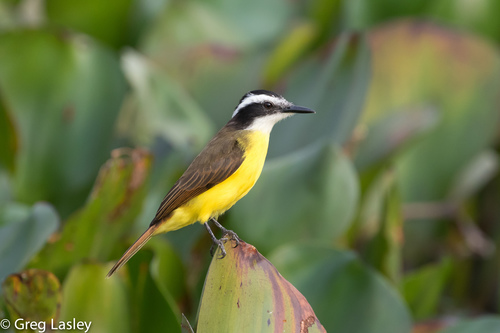
Lesser Kiskadee
Philohydor lictor
A slender specialist of the shoreline, the Lesser Kiskadee is the elegant, water-loving relative of the Great Kiskadee. With its striking yellow plumage and sharp hunting instincts, it is a master of the tropical riverbank.
Quick Identification
Size
Length: 15.5–18 cm (6.1–7.1 in); Weight: 22–26 g (0.77–0.92 oz)
Colors
Bright yellow underparts, white throat, and black head with a bold white stripe (supercilium) above the eye. Back and wings are olive-brown with rufous (reddish) edges on the wing feathers.
Key Features
- Slender, elongated black bill
- Broad white eyebrow contrasting with black crown and eye-mask
- Bright yellow belly and chest
- White throat patch
When You’ll See Them
Geographic range
Where Does the Lesser Kiskadee Live?
Native to the tropical Americas, the Lesser Kiskadee is found from eastern Panama across the northern and central regions of South America. Its core range encompasses the massive Amazon Basin, extending through Colombia, Venezuela, and the Guianas down into Brazil and northern Bolivia. While it is a common resident across these humid lowlands, it is notably absent from the high altitudes of the Andes and the drier regions of the southern cone.
Basemap © OpenStreetMap contributors
Behavior
The Lesser Kiskadee is a specialized flycatcher that is almost always found near water. Unlike its bolder, more famous cousin, the Great Kiskadee, this species is somewhat more refined in its habits, preferring to perch on low-hanging branches or reeds just inches above the water's surface. From these vantage points, it performs short, hovering sorties to snatch insects from the air or small aquatic prey from the water.
Socially, they are often seen in pairs or small family groups. They are highly territorial during the breeding season and will actively defend their nesting sites, which are usually messy, globular structures built in bushes overhanging the water. While they are vocal, their call is a thinner, more buzzy 'wueee' or 'd-d-d-reet' compared to the loud, boisterous shouting of other large flycatchers.
EverydayEarth exclusive
Camera Tips
To capture the Lesser Kiskadee on camera, you must focus on the water's edge. Position your camera approximately 2–4 feet above the ground, angled toward a semi-submerged branch or a prominent reed where the bird might perch to hunt. Because they are relatively small and move quickly, use a fast shutter speed (at least 1/1000s) if your camera allows, or use 'Burst Mode' to capture the moment they strike at the water.
Unlike many backyard birds, the Lesser Kiskadee rarely visits traditional seed feeders. However, if you have a garden pond or live near a canal, you can attract them by maintaining natural perching spots. Placing a horizontal branch about a foot above your pond can serve as an irresistible 'hunting jetty' for your camera to focus on.
The best light for these birds is early morning or late afternoon, as the low sun angle illuminates their yellow bellies against the dark water. If using an AI-triggered camera, ensure the sensitivity is high enough to detect quick movements, as their fishing dives are over in a matter of seconds. Avoid placing cameras in areas with heavy wind-blown vegetation, as the movement of reeds can cause many false triggers in wetland environments.
Similar Species
Species that look similar or are commonly confused with Lesser Kiskadee.
Great Kiskadee
Much larger with a massive, thick black bill and a very loud, distinctive three-syllable call.
Social Flycatcher
Smaller with a very short bill and lacks the rufous (reddish) edges on the wing and tail feathers.
Rusty-margined Flycatcher
Almost identical in plumage but prefers open scrub and gardens rather than strictly staying near water.
Frequently Asked Questions
Record Lesser Kiskadee at your habitat
Connect a camera to start building your own species record — AI identifies every visitor automatically.