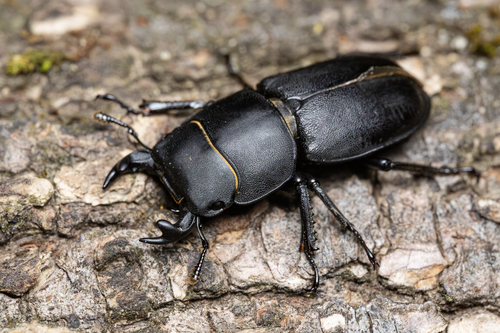
Lesser Stag Beetle
Dorcus parallelipipedus
The Lesser Stag Beetle is a sturdy, matte-black 'lumberjack' of the backyard. Frequently found near old wood, these fascinating beetles are proof that you don't need 'antlers' to be a garden heavyweight.
Quick Identification
Size
18-32 mm (0.7-1.25 inches) in length
Colors
Uniformly matte black to very dark charcoal; unlike many beetles, they lack a metallic sheen.
Key Features
- Broad, rectangular head and thorax giving a 'boxy' appearance
- Matte black finish on the wing cases (elytra)
- Distinctive elbowed antennae with a comb-like club at the end
- Males have slightly larger, inward-curving mandibles than females
When You’ll See Them
Behavior
The Lesser Stag Beetle is a dedicated recycler of the insect world. Unlike their more famous cousins, the Greater Stag Beetles, these insects are much more common in suburban environments and are often found wandering across garden paths or clinging to tree bark. They are primarily nocturnal, spending their days hidden beneath logs or in leaf litter to avoid predators like birds and hedgehogs. When dusk falls, they emerge to find mates or feed on oozing tree sap.
While they are capable of flight, they are somewhat clumsy in the air and are more frequently seen walking. They are not aggressive and are completely harmless to humans; their small mandibles are designed for gripping wood or competing with other males rather than biting. In the garden, they are a sign of a healthy ecosystem, as their presence indicates a good supply of decaying wood which supports a wide variety of other beneficial organisms.
EverydayEarth exclusive
Camera Tips
To capture high-quality footage of the Lesser Stag Beetle, your camera needs to be positioned close to the ground, specifically near 'deadwood habitats.' If you have a log pile, an old tree stump, or even a wooden garden border, aim your camera about 4-6 inches off the ground. Since these beetles are matte black, they absorb light rather than reflecting it; if your camera has adjustable infrared (IR) intensity, set it to a medium-high level to ensure the beetle doesn't just look like a moving shadow.
Because they are attracted to fermenting sugars, you can create a 'beetle station' to lure them into your camera's field of view. Place a slice of overripe banana or a sponge soaked in sugary water and beer near a log. This will often encourage them to stay in one spot for several minutes, allowing your AI camera to trigger and record a clear sequence. If you are using a camera with a macro lens or a close-focusing distance, this is the perfect subject, as they move relatively slowly compared to ground beetles.
Timing is everything with this species. They are most active on warm, humid evenings after a period of rain. Ensure your PIR (passive infrared) sensor sensitivity is set to 'High,' as small insects don't always generate enough heat to trigger sensors at a distance. If your camera supports 'Time Lapse' mode, setting it to take a photo every 30 seconds during the first few hours of darkness can be a great way to catch them if the motion sensor misses their slow movements.
Frequently Asked Questions
Record Lesser Stag Beetle at your habitat
Connect a camera to start building your own species record — AI identifies every visitor automatically.