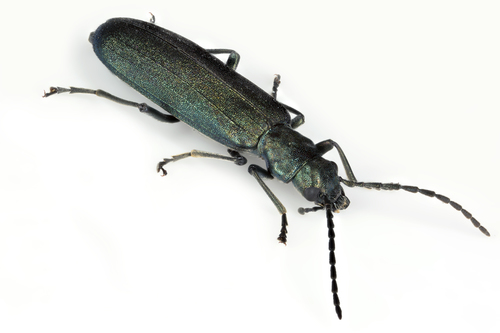
Lesser Thick-legged Flower Beetle
Ischnomera cyanea
A shimmering jewel of the late spring garden, the Lesser Thick-legged Flower Beetle dazzles with its metallic blue-green coat. Often found lounging on Hawthorn blossoms, this tiny beetle is a fascinating indicator of a healthy, wood-rich ecosystem.
Quick Identification
Size
6–8 mm (0.24–0.31 inches) in length
Colors
Brilliant metallic blue-green or turquoise body with dark, brownish-black antennae and legs
Key Features
- Metallic iridescent sheen across the entire body
- Elongated, soft-bodied physique
- Long, thread-like (filiform) antennae
- Males possess slightly thickened hind thighs (femora)
When You’ll See Them
Geographic range
Where Does the Lesser Thick-legged Flower Beetle Live?
Native to the European continent, the Lesser Thick-legged Flower Beetle is a widespread resident of temperate woodlands and traditional hedgerows. Its core range extends from the British Isles across Central Europe to the Caucasus, with significant populations found in countries like France, Germany, and Poland. While often overlooked due to its small size, it thrives in landscapes where ancient deciduous trees are allowed to age and decay alongside flowering margins.
Basemap © OpenStreetMap contributors
Behavior
The Lesser Thick-legged Flower Beetle is a diurnal insect that emerges in late spring to take advantage of the season's first major blooms. They are most active on warm, sunny days when they can be found crawling slowly over flower heads. Despite their name, they are quite agile and will take flight quickly if they feel threatened or if the sun is obscured by clouds.
As adults, these beetles are primarily solitary, though several may congregate on a single high-quality nectar source like a Hawthorn bush. They are completely harmless to humans and lack the chemical defenses found in some of their larger 'Blister Beetle' relatives. Their life cycle is deeply connected to the forest floor, where their larvae spend one to two years developing within the moist, decaying wood of broadleaved trees.
EverydayEarth exclusive
Camera Tips
Capturing the Lesser Thick-legged Flower Beetle requires a specialized setup due to its small size. Use a camera with macro capabilities or a lens with a very short minimum focus distance. Position your camera within 6 to 10 inches of white-flowering shrubs like Hawthorn, Elder, or Cow Parsley. These beetles are highly attracted to white and cream-colored flowers that offer flat platforms for landing.
Since these insects are 'heliophilic' (sun-loving), your camera should be positioned in a south-facing, sun-drenched spot. They are rarely active in the shade or on overcast days. Set your AI trigger sensitivity to its highest level; because these beetles are only 8mm long, they may not trigger standard motion sensors unless they move directly across the center of the frame or land very close to the lens.
To document their full life cycle, consider placing a secondary camera near a 'bug hotel' or a pile of rotting hardwood logs in a shaded corner of the garden. While the adults feed in the sun, they emerge from these wooden nurseries in May. A time-lapse setting during the morning hours (8 AM to 11 AM) can capture the fascinating moment they crawl out of the wood and expand their wings for the first time.
Similar Species
Species that look similar or are commonly confused with Lesser Thick-legged Flower Beetle.
Frequently Asked Questions
Record Lesser Thick-legged Flower Beetle at your habitat
Connect a camera to start building your own species record — AI identifies every visitor automatically.