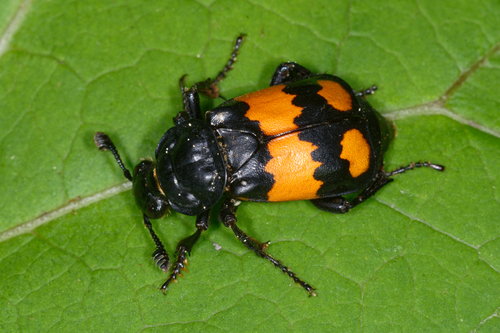
Lesser Vespillo Burying Beetle
Nicrophorus vespilloides
The forest's most colorful undertaker, the Lesser Vespillo Burying Beetle, is a master of recycling. Known for its devoted parental care and striking orange bands, this tiny beetle plays a massive role in maintaining healthy ecosystems.
Quick Identification
Size
12–20 mm (0.47–0.79 inches) in length
Colors
Deep black body with two prominent, jagged orange-yellow bands across the wing cases; entirely black antennae
Key Features
- Two bold, wavy orange-yellow bands on the elytra
- Antennae are entirely black (no orange tips)
- Wing cases (elytra) are squarish and shorter than the abdomen
- Straight hind tibiae (back legs)
- Aposematic coloration used to warn avian predators
When You’ll See Them
Geographic range
Where Does the Lesser Vespillo Burying Beetle Live?
The Lesser Vespillo Burying Beetle is a truly Holarctic species, boasting a massive range that spans the northern hemisphere. It is native to almost the entirety of Europe and northern Asia, including Russia, China, and Japan. In North America, it is frequently found across Canada and the northern United States, thriving in cool, moist forested environments where small vertebrate prey is abundant.
Basemap © OpenStreetMap contributors
Behavior
The Lesser Vespillo Burying Beetle is one of nature's most dedicated and complex parents. Often referred to as a 'Sexton Beetle,' this species is famous for its ability to locate the carcasses of small vertebrates, such as mice or songbirds, from great distances using highly sensitive chemoreceptors on its antennae. Once a suitable carcass is found, a male and female pair will work together to excavate the earth beneath it, slowly sinking the body into the ground to protect it from larger scavengers and competing flies.
Unlike the vast majority of insects, these beetles exhibit biparental care. They strip the carcass of fur or feathers, roll it into a ball, and treat it with antimicrobial secretions to slow decay. After the eggs hatch in the nearby soil, the parents actively feed the larvae by regurgitating liquefied food. They are also frequently seen carrying 'hitchhiking' mites (Poecilochirus); these mites are not parasites, but partners that eat fly eggs on the carcass, helping the beetle's own offspring survive by reducing competition.
EverydayEarth exclusive
Camera Tips
Capturing high-quality footage of the Lesser Vespillo Burying Beetle requires getting your camera down to ground level. Since these beetles spend their lives navigating the leaf litter, place your AI camera on a tripod mount or a flat stone just 2–5 inches above the forest floor. Ensure the lens is angled slightly downward to capture the beetle's distinctive orange markings and black antennae. Because they are relatively small, a camera with macro capabilities or a close-focusing range is ideal for identifying the species accurately.
To guarantee a sighting, you can create a 'scent station.' Place a small piece of raw meat or a fresh, unseasoned chicken wing inside a small, sturdy mesh cage or a perforated container. This prevents local cats, foxes, or raccoons from carrying the bait away while allowing the beetle's keen sense of smell to lead it directly into your camera's field of view. Secure the container to the ground with a tent stake so the beetles can crawl around it without the 'bait' shifting out of frame.
Pay close attention to your camera's sensitivity settings. Beetles move with a jerky, rapid gait that can sometimes be missed by standard motion sensors designed for large mammals. Set your trigger speed to its highest setting and choose a multi-shot burst mode. If you are using an AI-powered camera, ensure the software is updated to recognize insects. While they are active both day and night, you will get the best color definition during the warm afternoon hours when their orange bands appear most vibrant against the dark soil.
Frequently Asked Questions
Record Lesser Vespillo Burying Beetle at your habitat
Connect a camera to start building your own species record — AI identifies every visitor automatically.