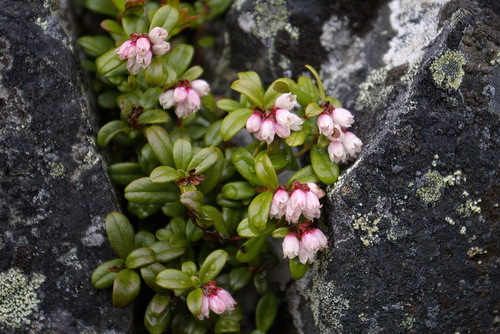
Lingonberry
Vaccinium vitis-idaea
A hardy survivor of the far north, the Lingonberry is a vibrant evergreen shrub famous for its tart, crimson fruits and glossy leaves. Thriving in the world's coldest forests, it provides a vital winter food source for wildlife and a beloved harvest for foragers.
Quick Identification
Size
Height: 5-30 cm (2-12 inches); Spread: Indeterminate via underground rhizomes.
Colors
Deep glossy green leaves (lighter underside with black spots), white to pale pink flowers, and vibrant crimson-red berries.
Key Features
- Low-growing evergreen shrub with woody stems
- Leathery, oval leaves with slightly rolled edges
- Bell-shaped white or pink flowers blooming in early summer
- Bright red, acidic berries that persist through winter
When You’ll See Them
Geographic range
Where Does the Lingonberry Live?
The Lingonberry is a circumpolar species native to the vast northern reaches of the Northern Hemisphere, spanning North America, Europe, and Northern Asia. Its core range includes the boreal forests of Canada, the Nordic countries of Scandinavia, and the Russian Siberia, though it also thrives in the mountainous regions of the United Kingdom and the northern United States. This hardy shrub is a hallmark of the Arctic tundra and subarctic climates, where it blankets the forest floor in acidic, well-drained soils.
Basemap © OpenStreetMap contributors
Behavior
The Lingonberry is a resilient evergreen shrub that spreads primarily through an extensive network of underground runners or rhizomes. This allows it to form dense mats on the forest floor, which can live for many decades. Unlike many other berries, Lingonberries are remarkably cold-hardy, surviving temperatures as low as -40°C, and they often keep their foliage throughout the winter, providing a splash of green in snowy landscapes.
As a vital part of the ecosystem, Lingonberries have a fascinating relationship with local wildlife. In the spring, their nectar-rich flowers attract bees and butterflies, while in the late summer and autumn, the ripening fruit becomes a feast for bears, foxes, and various birds. Because the berries are naturally high in benzoic acid, they act as a long-lasting food source that resists rot, often remaining edible for wildlife well into the following spring.
EverydayEarth exclusive
Camera Tips
To capture the beauty of Lingonberries, position your camera at a very low 'worm’s eye' view. Since these shrubs rarely exceed a foot in height, a ground-level mount or a small tripod is essential. Aim for a 45-degree downward angle to capture both the glossy texture of the leaves and the clusters of bright red berries. If your camera has a macro mode or a close-focus lens, use it to highlight the black glandular dots on the leaf undersides, which are a key identification feature.
While the plant itself is stationary, your trail camera can capture the high-traffic wildlife activity around it. Set your camera to 'Hybrid Mode' (photo plus video) near a healthy patch of berries during late August and September. This is when foragers like bears, foxes, and grouse frequent the bushes. Use a high-sensitivity PIR setting to ensure the camera triggers even for smaller birds landing on the branches to pluck the fruit.
For a unique perspective, try a time-lapse setting over several weeks in late summer. Lingonberries go through a beautiful color transition from pale green-white to a deep, waxy crimson. Setting the camera to take one photo every 4-6 hours during daylight will allow you to create a stunning sequence of the ripening process. Ensure the area is clear of tall grass that might blow in the wind and cause false triggers or obscure the view of the berries.
Lighting is crucial for plant photography. If possible, position your camera facing North or South to avoid the harsh glare of a rising or setting sun. Lingonberries often grow in the dappled light of coniferous forests; using a camera with a high dynamic range (HDR) setting will help prevent the bright red berries from looking 'blown out' in sunny patches while keeping the dark green foliage visible in the shadows.
Frequently Asked Questions
Record Lingonberry at your habitat
Connect a camera to start building your own species record — AI identifies every visitor automatically.