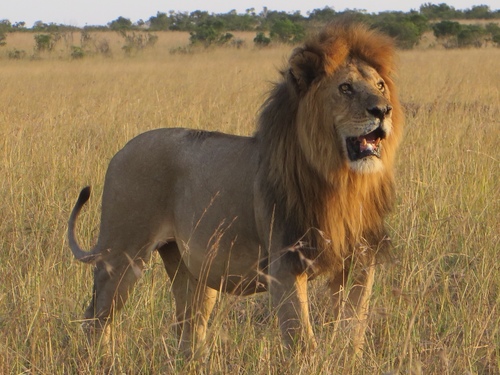
Lion
Panthera leo
The lion is the world's most social big cat, a symbol of strength and majesty that rules the African savanna in powerful family prides. From their thunderous roars to their coordinated hunts, these apex predators are the undisputed icons of the wild.
Quick Identification
Size
Length: 1.4 to 2.5 meters (4.6 to 8.2 feet); Weight: 120 to 250 kilograms (265 to 550 pounds)
Colors
Uniform tawny, buff, or sandy-brown coat; adult males feature thick manes ranging from blonde to black
Key Features
- Large, muscular frame with a broad chest
- Distinctive dark hair tuft at the tip of the tail
- Adult males possess a prominent mane around the head and neck
- Short, rounded ears and powerful, thick-set limbs
When You’ll See Them
Sightings on EverydayEarth
Jul 31, 2026
A lioness is resting in the shade of some bushes in the grass. She is alert, turning her head to look toward the left of the frame, likely scanning for movement in the woodland.
Jul 30, 2026
A wide view of a watering hole shows several hippos submerged in the water. The camera then focuses on a lioness resting in the dappled shade of nearby bushes, looking alert as the wind blows through the surrounding vegetation.
Jul 30, 2026
The scene begins with a panoramic view of the sun rising over the South African bushveld, silhouetting the acacia trees. The view then cuts to a close-up of a lioness sitting calmly in the grass, turning her head slightly as she scans the environment.
Jul 29, 2026
A diverse group of waterbirds is active at a riverbank in the Laikipia woodland. A large Goliath Heron stands prominently on a fallen log in the water, while a Black-headed Heron perches on a nearby rock. On a rocky outcrop in the foreground, an Egyptian Goose and a Great Egret are seen standing together. Separately, a lioness is resting in the grass under the shade of a bush during the cooler morning hours.
Jul 27, 2026
A lion is perched on a rocky outcrop in the middle of a river at night. The animal is seen looking around while its deep, rhythmic grunting calls resonate through the area. A spotlight pans across the scene, highlighting the lion and the surrounding water.
Jul 27, 2026
The footage shows a variety of wildlife in an East African habitat. Several hippos are submerged in the Ewaso Ng'iro river, resting near large rocks. On the far hillside, several giraffes can be seen moving through the scrubland. A highlight cut shows a female lion resting in the shade of a bush, turning her head to look toward the camera.
Geographic range
Where Does the Lion Live?
The lion reigns primarily over the vast savannas and grassy plains of Sub-Saharan Africa, with core populations found in wildlife strongholds like Tanzania, Kenya, South Africa, and Botswana. Once roaming across Europe, the Middle East, and most of Africa, their modern range is now highly fragmented and largely restricted to protected national parks and reserves. A tiny, isolated population of the Asiatic lion subspecies still survives in the Gir Forest of India, representing the species' last remaining wild foothold outside of the African continent.
Basemap © OpenStreetMap contributors
Recorded on EverydayEarth
Behavior
Lions are unique among the great cats as they are the only truly social species, living in complex family units known as prides. These prides are usually matrilineal, consisting of related females and their cubs, defended by a small coalition of dominant males. This social structure allows for communal cub rearing and highly coordinated hunting strategies that enable them to take down prey much larger than themselves.
Much of a lion's day—often up to 20 hours—is spent resting in the shade to conserve energy. They are most active at night and during the cooler twilight hours of dawn and dusk. While they are fearsome apex predators, they also play a vital role as scavengers, often chasing other predators away from kills. Their interactions with humans are generally cautious, though they can become bold in areas where habitat loss forces them into contact with livestock.
EverydayEarth exclusive
Camera Tips
Capturing the 'King of Beasts' on a trail camera requires heavy-duty preparation and strategic placement. Because lions are incredibly powerful and naturally curious, an unprotected camera can easily become a chew toy. It is essential to house your camera in a steel security box (often called a 'bear box') and secure it to a sturdy tree or post using lag bolts rather than just a strap. This prevents the lion from ripping the camera off or altering its angle through grooming or rubbing.
Position your camera along well-worn game trails or near permanent water sources, as these are the arteries of the savanna that lions use for patrol and hunting. Aim for a mounting height of about 3 to 4 feet (approx. 1 meter) to capture a full-body profile. Since lions are crepuscular and nocturnal, high-quality Infrared (IR) night vision is a must. 'No-Glow' IR is preferable to avoid spooking the pride or drawing the attention of passersby in high-traffic wildlife areas.
To capture the social dynamics of a pride, set your camera to 'Burst Mode' or record short 20-30 second video clips. A single photo often misses the rest of the pride following the lead animal. By using video, you are much more likely to capture fascinating behaviors like cubs playing, social grooming, or the powerful vocalizations of a male marking his territory. Use high-speed SD cards and lithium batteries to ensure the camera can handle the heat and the rapid-fire triggers common in prey-rich environments.
Similar Species
Species that look similar or are commonly confused with Lion.
Frequently Asked Questions
Record Lion at your habitat
Connect a camera to start building your own species record — AI identifies every visitor automatically.