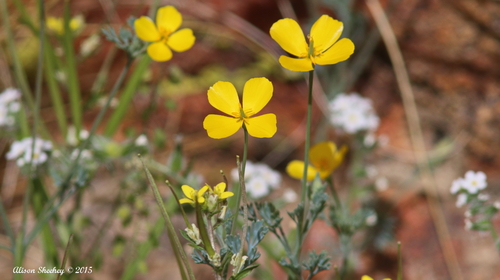
Little Gold Poppy
Eschscholzia minutiflora
A miniature masterpiece of the arid West, the Little Gold Poppy proves that beauty doesn't have to be big to be breathtaking. This hardy desert survivor waits for years beneath the sand, emerging after spring rains to paint the landscape in brilliant, microscopic gold.
Quick Identification
Size
5–35 cm (2–14 inches) in height with flower diameters of only 3–6 mm (0.1–0.25 inches)
Colors
Bright lemon-yellow to deep gold petals, often with a subtle orange tint at the base; foliage is a distinctive glaucous grayish-green
Key Features
- Extremely small cup-shaped flowers often less than a quarter-inch wide
- Finely divided, fern-like leaves with a waxy blue-green coating
- Long, slender green seed pods that turn brown and split when mature
- Low-growing, branching habit that forms delicate tufts
When You’ll See Them
Behavior
The Little Gold Poppy is a resilient desert annual that has mastered the art of timing in the harsh American Southwest. Unlike its larger, flashier relatives, this species focuses on rapid reproduction following winter rains. It exhibits a behavior known as nyctinasty, where the tiny petals sensitive to light and temperature curl inward at night or during overcast weather to protect their pollen from moisture and cold.
While it may appear solitary, this poppy often participates in 'superblooms' where thousands of individuals germinate simultaneously, creating a subtle golden haze across desert flats. It provides a critical early-season food source for specialized native bees and small hoverflies that are small enough to navigate its miniature blooms. Because it is an ephemeral annual, it spends the vast majority of its life cycle as a dormant, drought-resistant seed buried in the sand.
EverydayEarth exclusive
Camera Tips
Capturing the Little Gold Poppy requires a specialized approach because of its diminutive size. To get professional-grade shots, you must get your camera down to the plant's level. Use a low-profile tripod or a ground-mount; positioning the lens just 6 inches off the ground creates a 'forest of flowers' effect that makes these tiny plants look majestic. If your AI camera has a macro mode or a close-focus lens, this is the time to use it, as the intricate details of the stamens are nearly invisible to the naked eye.
Time-lapse photography is the most rewarding way to document this species. Program your camera to take a photo every 60 seconds starting just after dawn. When played back, you will see the dramatic spiral movement as the petals unfurl to greet the sun. This 'waking up' process is a signature trait of the poppy family and makes for a captivating video sequence that highlights the plant's responsiveness to its environment.
Wind is the greatest challenge when photographing the Little Gold Poppy. Their stems are thin and wire-like, causing the flowers to bob significantly in even a light desert breeze. To ensure sharp images, use a fast shutter speed (at least 1/500s) or set up a small, transparent windbreak just out of the frame. If you are using a trail camera with motion-triggering, be aware that wind-blown poppies can cause 'false triggers,' so consider using a timed interval capture during the peak blooming hours of 10 AM to 2 PM.
Lighting can make or break your wildflower captures. The golden petals of the Little Gold Poppy can become 'blown out' or lose detail in harsh, direct midday sun. The best results often come from 'backlighting' the flowers during the late afternoon. When the sun shines through the translucent yellow petals from behind, they appear to glow from within. Position your camera facing toward the sun (but with the lens shaded) to capture this ethereal, luminous quality.
Similar Species
Species that look similar or are commonly confused with Little Gold Poppy.
Frequently Asked Questions
Record Little Gold Poppy at your habitat
Connect a camera to start building your own species record — AI identifies every visitor automatically.