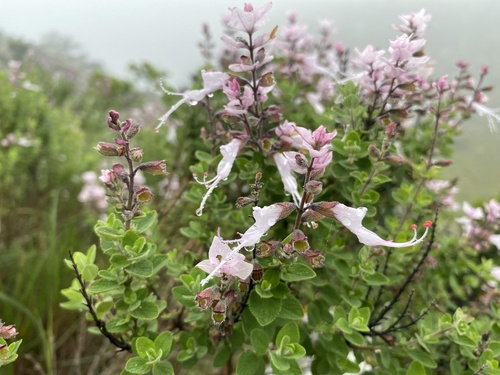
Littleleaf Sagebush
Syncolostemon parvifolius
A pollinator's paradise in a compact, aromatic package, the Littleleaf Sagebush is a hardy survivor that paints the landscape in shades of pink and purple. It's the ultimate 'busy' plant for any backyard enthusiast looking to attract rare bees and butterflies.
Quick Identification
Size
Height: 0.5–1.5 m (1.6–5 ft); Spread: 0.5–1 m (1.6–3.3 ft)
Colors
Deep green to grayish-green foliage; flowers are vibrant pink, mauve, or pale purple with reddish-brown stems.
Key Features
- Upright, woody shrub with square-shaped stems
- Tiny, oval aromatic leaves under 10mm in length
- Terminal spikes of tubular pink or purple flowers
- Dense, multi-branched growth habit
When You’ll See Them
Behavior
The Littleleaf Sagebush is a hardy, aromatic shrub that serves as a vital anchor for biodiversity in rocky and grassland ecosystems. While it may appear as a modest green bush for much of the year, it undergoes a spectacular transformation during its flowering season. It doesn't just sit still; it actively interacts with its environment by producing a wealth of nectar in its tubular blooms, specifically designed to accommodate the anatomy of long-tongued insects and small birds.
This species is highly resilient, adapted to survive periods of drought and poor soil quality. In a backyard or garden setting, it acts as a social hub for local wildlife. When the leaves are brushed by a passing animal or a gardener, they release a sharp, pleasant sage-like fragrance—a chemical defense mechanism that also adds a sensory dimension to the landscape. It is a 'community' plant, often found growing alongside other fynbos or grassland species, providing cover for ground-dwelling creatures while its flowers feed the aerial ones.
EverydayEarth exclusive
Camera Tips
To capture the best action on your Littleleaf Sagebush, position your AI camera approximately 2 to 3 feet away from a dense cluster of flower spikes. Because the flowers are small and move easily in the wind, use a high shutter speed or 'action' mode if your camera allows it to prevent motion blur. Angling the camera slightly upward from a mid-shrub height (about 0.5 meters) often yields the most dramatic shots of visiting insects against the sky or a soft-focus background, which helps the AI identification software isolate the subject.
Time-lapse mode is particularly rewarding with this species. Set your camera to take a photo every 15-30 minutes during the late summer to document the 'bloom explosion.' You'll see the spikes elongate and the buds transition from green to deep pink over the course of several weeks. For wildlife triggers, focus your detection zone on the upper third of the plant where the flower spikes are concentrated, as this is where 90% of the movement will occur.
Since the Littleleaf Sagebush is a 'pollinator buffet,' the best time for activity is mid-morning when nectar production is highest and the sun has warmed the insects. If you are using a camera with a macro lens, this is the perfect time to deploy it. In suburban settings, ensure there is no distracting moving foliage in the immediate foreground, as the thin stems of the sagebush can dance vigorously in a breeze, potentially causing false triggers or blurry images.
Finally, consider the lighting. Because the Littleleaf Sagebush thrives in full sun, mid-day glare can wash out the delicate pink of the flowers. Try to position your camera so the sun is behind it or to the side. This 'side-lighting' highlights the texture of the tiny leaves and the translucent quality of the flower petals, creating a much more vivid image for your collection.
Frequently Asked Questions
Record Littleleaf Sagebush at your habitat
Connect a camera to start building your own species record — AI identifies every visitor automatically.