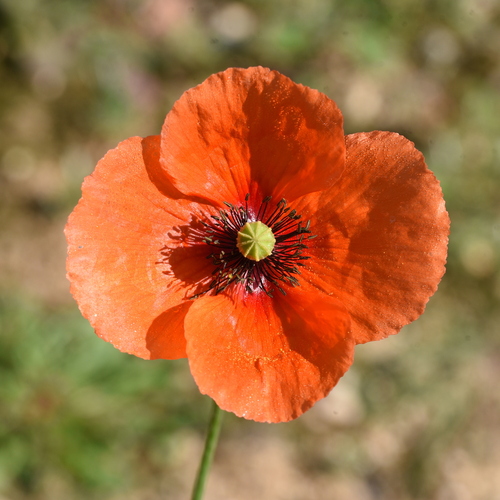
Long-headed poppy
Papaver dubium
A slender and elegant wildflower, the Long-headed poppy is a master of the sandy landscape, known for its soft salmon-colored petals and unique, club-shaped seed pods.
Quick Identification
Size
Height: 30-60 cm (12-24 inches); Flower diameter: 3-7 cm (1.2-2.7 inches)
Colors
Pale red to salmon-orange petals, light green stems, and grey-green foliage
Key Features
- Elongated, smooth seed capsule at least twice as long as it is wide
- Stiff hairs on the flower stalks are pressed flat (appressed) against the stem
- Four delicate petals that usually do not overlap at the edges
- Deeply lobed, feathery leaves that form a basal rosette before flowering
When You’ll See Them
Behavior
The Long-headed poppy is a hardy annual that specializes in colonizing disturbed ground. Unlike the more robust Common Poppy, this species has a slender, almost fragile appearance. It follows a rapid life cycle, germinating in the autumn or spring and producing blooms that often last only 24 to 48 hours. The flowers are highly phototropic, orienting themselves toward the sun to maximize the warmth for visiting pollinators.
While it lacks nectar, it produces an abundance of dark pollen, making it a favorite for hoverflies and solitary bees. Once the petals drop, the plant focuses all its energy on its distinctive long seed capsule. As the capsule dries, small pores open at the top, allowing the wind to shake out thousands of tiny seeds in a mechanism known as 'anemochory' or wind-dispersal. This ensures the species can spread effectively across sandy roadsides and garden borders.
EverydayEarth exclusive
Camera Tips
To capture the Long-headed poppy effectively, you need to get low. Place your AI-powered camera on a ground-level mount or a short tripod, aiming for a lens height of about 10 to 15 inches. This perspective allows the camera to see the 'face' of the flower and the unique elongated seed pod simultaneously. Because the petals are thin and somewhat translucent, try to position your camera so the flowers are backlit by the morning sun; this creates a glowing effect that highlights the delicate texture of the bloom.
Time-lapse is the ultimate setting for this species. Set your camera to take a frame every 5 minutes from 6:00 AM to 11:00 AM. This will document the dramatic 'emergence' phase, where the hairy green sepals split and fall away to reveal the tightly crumpled petals expanding into their full shape. Since these poppies are lightweight and sway in the slightest breeze, use a fast shutter speed (1/500 or higher) if your camera allows manual overrides, or ensure the area is somewhat sheltered from high winds to prevent motion blur in your AI triggers.
For the best results with AI detection, focus on the center of the flower. Many backyard cameras are programmed to recognize movement; by focusing on the flower's reproductive center, you are more likely to capture high-quality 'action' shots of hoverflies and wild bees as they land. If you are monitoring the plant later in the season, keep the camera active to record the seed dispersal process. The swaying of the dried 'pepper-pot' capsules makes for fascinating video clips that demonstrate how the plant spreads its next generation.
Similar Species
Species that look similar or are commonly confused with Long-headed poppy.
Frequently Asked Questions
Record Long-headed poppy at your habitat
Connect a camera to start building your own species record — AI identifies every visitor automatically.