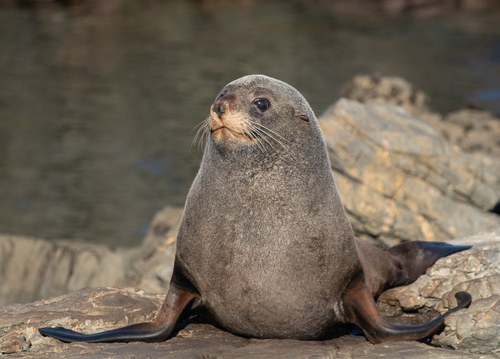
Long-nosed Fur Seal
Arctocephalus forsteri
Master of the rugged southern coastlines, the Long-nosed Fur Seal is a testament to conservation success. With its elegant pointed muzzle and surprising agility on land, this seafaring mammal is a favorite for coastal wildlife watchers.
Quick Identification
Size
Males reach 1.5–2.5m (4.9–8.2ft) and 120–200kg (265–440lb); females are smaller at 1.2–1.5m (3.9–4.9ft) and 30–50kg (66–110lb).
Colors
Uniform dark grey-brown to charcoal upperparts that appear black when wet; paler silver-grey undersides and a creamy muzzle.
Key Features
- Distinctly long, pointed snout with prominent whiskers
- Small but visible external ear flaps (pinnae)
- Dense, two-layered coat of fur
- Hind flippers that can rotate forward for walking on land
When You’ll See Them
Geographic range
Where Does the Long-nosed Fur Seal Live?
Native to the cool temperate waters of the Southern Hemisphere, the Long-nosed Fur Seal is primarily found along the southern coastline of Australia and throughout New Zealand. Its range extends from the southwestern tip of Western Australia across the Great Australian Bight to Victoria and Tasmania, while in New Zealand, it inhabits the mainland coasts as well as the Chatham and Subantarctic islands. These seals are increasingly seen reclaiming historical territories as populations recover from 19th-century sealing.
Basemap © OpenStreetMap contributors
Behavior
Socially, they are gregarious, often found in large colonies. During the breeding season, males become highly territorial and vocal, defending patches of coastline through displays and occasionally physical combat. Outside of breeding, they are more relaxed, spending hours grooming their thick fur to maintain its insulating properties and basking in the sun to regulate their body temperature.
While generally wary of humans, they are curious and may approach divers or boats. However, on land, they can be defensive if they feel cornered. They are deep divers, often reaching depths of over 200 meters in search of prey, and can remain at sea for days or weeks at a time before returning to the coast.
EverydayEarth exclusive
Camera Tips
Capturing the Long-nosed Fur Seal requires focusing on 'haul-out' sites—the specific rocky ledges and boulder fields where they emerge from the sea. Look for rocks that appear smoothed or polished by frequent use, or areas where seal scat is present. Mount your camera 2 to 4 feet (0.6 to 1.2 meters) off the ground on a stable rock or post, as these animals are low to the ground. Ensure the camera is angled slightly downward to capture the full body as they move between the waterline and their resting spots.
Because coastal environments are notoriously harsh, a high-quality waterproof and salt-resistant housing is essential. Salt spray can quickly cloud a lens, so check and clean the camera glass frequently with fresh water and a microfiber cloth. Position the camera to avoid direct sun glare off the ocean, which can trigger the PIR sensor unnecessarily or wash out your images; a north-facing orientation (in the Southern Hemisphere) is usually best for consistent lighting.
Trigger speed is vital because, despite their bulk, these seals can move with surprising speed when startled or during social squabbles. Set your camera to 'Burst Mode' to capture a sequence of movements, which helps in identifying individual markings or behaviors like grooming. Since they are active both day and night, ensure your camera has a high-quality infrared flash that won't startle the animals during their nocturnal rest periods. Avoid using any food lures, as these are wild animals protected by law; their natural curiosity and habitual use of paths are usually enough to get great shots.
Similar Species
Species that look similar or are commonly confused with Long-nosed Fur Seal.
Frequently Asked Questions
Record Long-nosed Fur Seal at your habitat
Connect a camera to start building your own species record — AI identifies every visitor automatically.