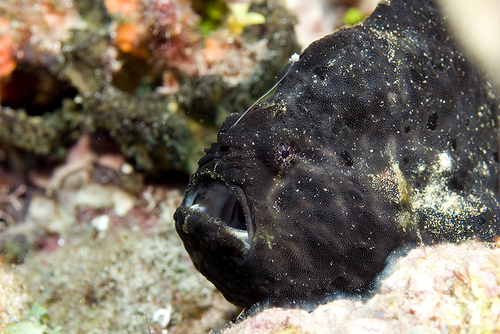
Longlure Frogfish
Antennarius multiocellatus
Meet the Atlantic's most patient angler, a fish that 'walks' on its fins and uses a built-in lure to hunt. The Longlure Frogfish is the ultimate master of mimicry, hiding in plain sight among the colorful sponges of the reef.
Quick Identification
Size
Typically 3 to 5 inches (7.5 to 12.5 cm) in length, with a maximum around 5.5 inches.
Colors
Extremely variable; can appear in shades of bright yellow, red, orange, green, or brown, often decorated with dark, circular 'ocelli' (eye spots) that mimic sponge pores.
Key Features
- Extremely long 'fishing rod' (illicium) nearly twice the length of the second dorsal spine
- Modified pectoral fins that function like feet for 'walking'
- Body covered in small bumps and spots to mimic sea sponges
- Large, upward-turned mouth capable of lightning-fast suction.
When You’ll See Them
Geographic range
Where Does the Longlure Frogfish Live?
This fascinating master of disguise is native to the warm, tropical waters of the Western Atlantic Ocean. Its range begins along the coast of Florida and the Bahamas, extending through the entire Caribbean Sea and the Gulf of Mexico. From there, it can be found along the Central American coastline and down the South American coast as far as southeast Brazil, flourishing anywhere healthy reef and sponge ecosystems exist.
Basemap © OpenStreetMap contributors
Behavior
The Longlure Frogfish is a master of camouflage and a sedentary ambush predator. It spends the vast majority of its time perfectly still, perched on or near sponges that match its current color. Rather than swimming like a typical fish, it uses its hand-like pectoral fins to crawl across the reef or brace itself against currents. This 'walking' behavior is a hallmark of the Antennariidae family and allows them to navigate complex reef structures without attracting the attention of predators or prey.
When hunting, the frogfish deploys its secret weapon: a modified dorsal spine known as an illicium, tipped with a fleshy lure (esca). It waves this lure to mimic the movement of a small shrimp or worm. When a curious fish approaches, the frogfish expands its oral cavity so rapidly that it creates a vacuum, swallowing the prey in as little as six milliseconds—one of the fastest feeding strikes in the animal kingdom. They are generally solitary and can change their base color over several weeks to blend into a new environment.
EverydayEarth exclusive
Camera Tips
Capturing the Longlure Frogfish on an underwater trail camera requires a shift in perspective. You aren't looking for a moving fish; you are looking for a sponge with a face. Identify a healthy reef area with plenty of tube or barrel sponges in 10 to 30 feet of water. Mount your camera securely using a weighted base or a specialized underwater tripod, as even a small amount of surge can ruin the shot or cause constant false triggers. Position the lens about 12-18 inches from a likely sponge, focusing on any 'outcrops' that look slightly different from the surrounding texture.
Because these fish are stationary for hours, standard motion detection can be tricky. Use a camera that supports 'Hybrid Mode'—taking a time-lapse photo every 2 to 5 minutes while keeping the motion sensor active. This ensures that even if the fish doesn't move enough to trigger the sensor, you still capture its presence and the subtle waving of its fishing lure. If your setup includes artificial lighting, use wide-angle video lights rather than a direct flash to avoid 'washing out' the incredible textures and color patterns of the fish's skin.
Check your camera's white balance settings or use a red filter to ensure the vibrant reds and yellows of the frogfish are accurately represented, as water quickly absorbs these colors. Seasonal clarity is more important than the time of year; choose days with low wind and minimal swell for the clearest footage. Be sure to camouflage the camera housing itself with dull, non-reflective materials so it doesn't frighten the small prey fish that the frogfish is trying to lure into the frame.
Frequently Asked Questions
Record Longlure Frogfish at your habitat
Connect a camera to start building your own species record — AI identifies every visitor automatically.