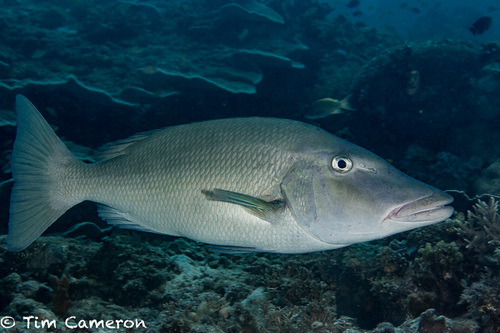
Longnose Emperor
Lethrinus olivaceus
The Longnose Emperor is the apex scout of the reef, instantly recognizable by its uniquely elongated snout and keen, watchful eyes. A master of camouflage and speed, it is one of the most prized sightings for coastal underwater camera enthusiasts.
Quick Identification
Size
Can reach up to 100 cm (3.3 ft) in length, though typically found around 70 cm (2.3 ft); weights up to 10 kg (22 lbs).
Colors
Olive-grey to brownish body with scattered dark blotches; snout features wavy dark lines; lips and fin bases often show a reddish-orange tint.
Key Features
- Extremely elongated, 'horse-like' snout profile
- Cheeks are smooth and completely scaleless
- Distinctive reddish color often present at the base of the pectoral fins
- Large, thick lips used for suction feeding
When You’ll See Them
Geographic range
Where Does the Longnose Emperor Live?
The Longnose Emperor is native to the expansive Indo-Pacific region, stretching from the Red Sea and East Africa across to French Polynesia. Its core range includes the tropical waters of Northern Australia, the Philippines, Indonesia, and as far north as the Ryukyu Islands of southern Japan. This species is a hallmark of healthy coral reef systems across the central and western Pacific Ocean.
Basemap © OpenStreetMap contributors
Behavior
The Longnose Emperor is a sophisticated marine predator known for its wary and intelligent behavior. Unlike many reef fish that stay tucked within coral branches, this species is a powerful swimmer that patrols the edges of reef drop-offs and deep lagoons. While juveniles are highly social and form large schools in shallow seagrass beds for protection, adults transition to a more solitary lifestyle or travel in small, loose-knit groups.
These fish are most active during daylight hours, utilizing their incredible sense of sight to track movement. They are known to be somewhat 'skittish' around divers but can be bold when hunting, often following larger rays or sharks to snatch up prey disturbed by the larger animals' movement through the sand. They also possess the ability to rapidly change their skin pattern from a solid olive to a mottled camouflage when hovering near the sea floor.
EverydayEarth exclusive
Camera Tips
To capture the Longnose Emperor on camera, you will need a dedicated underwater setup. For those with waterfront properties or access to docks, a submerged 'drop-cam' or a pier-mounted AI camera is ideal. Because these fish are easily spooked by bubbles and human movement, a stationary, silent camera rig will yield much more natural behavior than a handheld action camera. Position your lens to face a sandy clearing adjacent to a coral structure, as this is where they most frequently pause to hunt for prey buried in the substrate.
Lighting is the most critical factor for underwater AI detection. Mount your camera at a depth of 2-5 meters and angle it slightly downward to avoid the 'blown-out' effect of the sun's surface glare. The best footage is typically captured between mid-morning and early afternoon when the sun is highest, providing the best color penetration for the AI to recognize the olive-drab markings and the distinct long snout of this species. Use a housing with a high-quality glass port to maintain sharpness for the identification software.
If you are struggling to get them to stay within the frame, a scent-based lure can be very effective without being disruptive. Placing a small amount of crushed shellfish or oily fish in a perforated PVC pipe near the camera's focal point will encourage the Longnose Emperor to linger. They are curious fish; once they realize the camera is not a threat, they may even approach the lens to inspect their own reflection. Ensure your camera is set to a high frame rate (at least 60fps) to capture the lightning-fast strikes they make when they spot prey.
Similar Species
Species that look similar or are commonly confused with Longnose Emperor.
Frequently Asked Questions
Record Longnose Emperor at your habitat
Connect a camera to start building your own species record — AI identifies every visitor automatically.