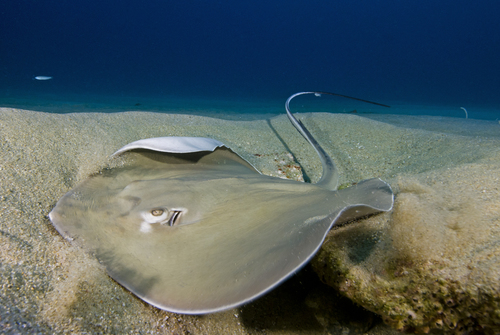
Longtail Stingray
Hypanus longus
A majestic glider of the Eastern Pacific, the Longtail Stingray is famous for its incredible whip-like tail and elegant, wing-like fins. Often found patrolling sandy shallows, this Near Threatened species is a master of camouflage and a favorite for coastal underwater observers.
Quick Identification
Size
Disc width up to 1.56 m (5.1 ft); total length including the whip-like tail can reach over 2.5 m (8.2 ft)
Colors
Dorsal surface is typically a uniform dark brown, charcoal grey, or reddish-brown; ventral (underneath) side is white with darker edges
Key Features
- Broad, rhomboid-shaped pectoral disc with pointed 'wings'
- Exceptionally long tail, often twice the length of the body when undamaged
- A row of sharp, thorny dermal denticles (scales) along the midline of the back and tail
When You’ll See Them
Geographic range
Where Does the Longtail Stingray Live?
The Longtail Stingray is native to the Eastern Pacific Ocean, hugging the continental shelf of the Americas. Its range begins in the north around the Gulf of California and Baja California, Mexico, and extends southward through the tropical waters of Central America to Colombia and northern Peru. This species is a permanent resident of these coastal waters and is not known to be introduced elsewhere.
Basemap © OpenStreetMap contributors
Behavior
The Longtail Stingray is a primarily solitary species that spends much of its time cruising the seafloor or lying partially buried in the sand. By using its pectoral fins to stir up the sediment, it creates a shallow depression where it can hide from predators like hammerhead sharks. While they are not aggressive, they are highly wary of sudden movements and will glide away gracefully if disturbed.
These rays are benthic hunters, meaning they focus their activity on the bottom. They utilize a specialized sense called 'electroreception' through organs known as the Ampullae of Lorenzini, allowing them to detect the tiny electrical impulses of prey hidden beneath the sand. When interacting with humans, they are generally shy, though they may frequent docks or coastal areas where fish scraps are present.
EverydayEarth exclusive
Camera Tips
Capturing a Longtail Stingray on camera requires an underwater setup, such as a waterproof trail camera or a stationary action camera mounted to a dock pile or a weighted base. Since these rays prefer sandy flats, place your camera in shallow water (3-6 feet deep) during high tide. Use a wide-angle lens to capture the full span of their impressive wings and tail as they glide past. Ensure the camera is angled slightly downward toward the seafloor to catch them as they forage.
To attract a Longtail Stingray to your field of view, scent is your best tool. You can use a perforated PVC pipe filled with oily fish scraps (like mackerel or sardines) anchored firmly in the sand about 3-5 feet in front of the camera. The rays will follow the scent trail against the current, often stopping to investigate the source, giving you ample time to record high-quality footage. Be sure to check local regulations regarding 'chumming' or baiting before setting your trap.
Visibility is the biggest challenge for marine backyard cameras. Plan your recording for days with low wind and calm seas to avoid 'murky' water caused by suspended sand. The best footage is often captured in the early morning or late afternoon when the sun is not directly overhead, reducing harsh reflections on the water's surface. If your camera has a high-frame-rate setting (60fps or higher), use it to capture the fluid, undulating motion of their pectoral fins in smooth slow-motion.
During the late summer months, you may be lucky enough to capture smaller juveniles or even birthing behavior in protected lagoons. Look for 'ray pits'—shallow, circular depressions in the sand—as these indicate a high-traffic area where rays have been excavating for food. Placing your camera near these natural foraging spots increases your chances of a sighting without the need for artificial lures.
Similar Species
Species that look similar or are commonly confused with Longtail Stingray.
Frequently Asked Questions
Record Longtail Stingray at your habitat
Connect a camera to start building your own species record — AI identifies every visitor automatically.