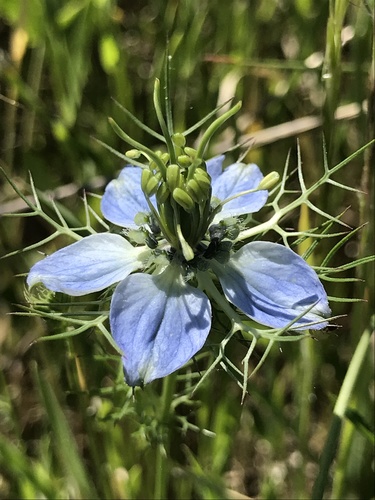
love-in-a-mist
Nigella damascena
A whimsical garden treasure, Love-in-a-mist captivates with its jewel-toned blue flowers wrapped in a haze of feathery green foliage. This resilient annual is as famous for its 'misty' appearance as its striking, balloon-like seed pods.
Quick Identification
Size
Grows to a height of 20-50 cm (8-20 inches) with a spread of 15-22 cm (6-9 inches).
Colors
Flowers are most commonly bright sky blue, but cultivars also produce white, pink, and pale violet blooms set against bright green foliage.
Key Features
- Delicate, feathery bracts that form a 'mist' around the flower
- Balloon-like inflated seed capsules with horn-like appendages
- Fine, thread-like leaves resembling fennel
- Five to ten petal-like sepals in pastel shades
When You’ll See Them
Geographic range
Where Does the love-in-a-mist Live?
Love-in-a-mist is native to the Mediterranean fringe, including Southern Europe, North Africa, and Southwest Asia. In its home range, it is frequently found on neglected, damp patches of land and rocky slopes. Because it is such a popular garden ornamental, it has successfully naturalized across much of North America, the United Kingdom, and parts of Australia, often appearing as a 'garden escape' in local meadows and roadsides.
Basemap © OpenStreetMap contributors
Behavior
Love-in-a-mist is a fast-growing annual plant known for its ethereal appearance and rapid life cycle. It germinates in the cool soil of early spring, quickly developing a mound of lacy foliage before sending up flower stalks. The flowers are relatively short-lived individually, but the plant produces them in a steady succession, ensuring a long-lasting display that attracts a wide variety of pollinators.
As the petals fall, the plant's behavior shifts toward seed production. The central ovary swells into a dramatic, striped, and inflated pod. These pods are designed for efficient seed dispersal; as they dry, they become papery and rattle in the wind, eventually splitting at the top to scatter dozens of small, black seeds. This prolific self-seeding behavior allows the species to 'move' around a garden or natural area, finding the best patches of soil to colonize for the following year.
EverydayEarth exclusive
Camera Tips
To capture the stunning transformation of Love-in-a-mist, set your camera to a time-lapse mode rather than simple motion triggers. Because the plant's 'movements' are slow growth and blooming cycles, taking one high-resolution still every 30 to 60 minutes during daylight hours will produce a breathtaking sequence of the flowers opening and the seed pods inflating. Position your camera on a sturdy ground stake about 12 inches from the flower head for the best angle.
If you are interested in the 'wildlife' aspect of the plant, focus on the pollinators. Use a macro lens or a close-up focus setting and set your camera to trigger on high-frequency motion. Love-in-a-mist is a magnet for honeybees and hoverflies; the best time for these shots is between 10 AM and 2 PM on sunny, still days when the nectar production is at its peak. Ensure the camera is angled to see into the center of the flower, where the intricate reproductive parts are located.
Don't pack your gear away once the flowers fade. The seed pods of Nigella damascena are incredibly photogenic, especially when backlit by the low evening sun. Position your camera to face the west during the late summer (August-September) to capture the translucent quality of the papery pods. Adjust your trigger settings to a lower sensitivity if it's a windy day, as the fine, feathery foliage can cause excessive 'false' triggers as it sways.
Frequently Asked Questions
Record love-in-a-mist at your habitat
Connect a camera to start building your own species record — AI identifies every visitor automatically.