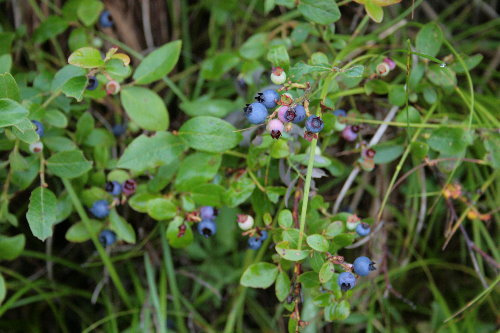
lowbush blueberry
Vaccinium angustifolium
The wild lowbush blueberry is more than just a summer treat; it's a foundation of the northern ecosystem, providing vital nectar for bees and a high-energy feast for birds and bears alike.
Quick Identification
Size
Height: 6–24 inches (15–60 cm); Spreading mats can extend several feet via underground rhizomes.
Colors
Foliage is bright green in summer and turns deep scarlet or burgundy in fall; berries are dark blue with a waxy white 'bloom'; flowers are white to pale pink.
Key Features
- Low-growing, woody shrub forming dense colonies
- Urn-shaped, drooping white or pink-tinged flowers
- Small, sweet, dark blue berries (5-10mm diameter)
- Alternate, lance-shaped leaves with finely serrated edges
When You’ll See Them
Behavior
The lowbush blueberry is a resilient, colonial shrub that spreads primarily through underground rhizomes rather than seeds. While a single plant may appear small, it is often part of a massive, interconnected clonal network that can live for decades. In the spring, it produces a profusion of bell-shaped flowers that are a critical early-season food source for bumblebees and other native pollinators.
As the season progresses, the plant focuses its energy on developing the 'low sweet' berries that are famous across the Northeast. Because it is a fire-adapted species, it actually thrives after moderate disturbances, which clear out taller competition and allow the sun-loving blueberry to dominate the forest floor. In the winter, the plant goes dormant, but its woody stems provide cover for small mammals navigating beneath the snowpack.
EverydayEarth exclusive
Camera Tips
Capturing the lowbush blueberry on a trail camera is less about the plant's movement and more about its role as a 'wildlife magnet.' To get the best shots, mount your camera very low to the ground—no higher than 12 inches. Angle the lens slightly upward to capture the underside of the bell-shaped flowers in spring, or level with the berry clusters in mid-summer. This low perspective creates a cinematic 'critter-eye view' of the animals that visit the patch.
Because lowbush blueberries are a preferred food for everything from black bears and foxes to cedar waxwings and chipmunks, positioning your camera near a healthy patch during July and August is a guaranteed way to see variety. Use a camera with a high-trigger speed and a good macro or 'near-focus' capability, as many visitors will be small birds or rodents appearing just inches from the lens. If your camera supports time-lapse mode, set it to take a photo every 15 minutes during the ripening phase to document the color transition from green to deep blue.
For the most vibrant colors, ensure the patch receives direct morning sunlight; the dew on the berries and the 'bloom' (the waxy coating) looks spectacular in the golden hour light. In the fall, the foliage turns a brilliant red that can provide a stunning backdrop for any wandering wildlife. Avoid using artificial lures; the berries themselves are the ultimate natural bait. If you are targeting specific birds, try to place a small, natural perch (like a weathered branch) just above the berry line, as birds will often land there to scout the patch before hopping down to feed.
Frequently Asked Questions
Record lowbush blueberry at your habitat
Connect a camera to start building your own species record — AI identifies every visitor automatically.