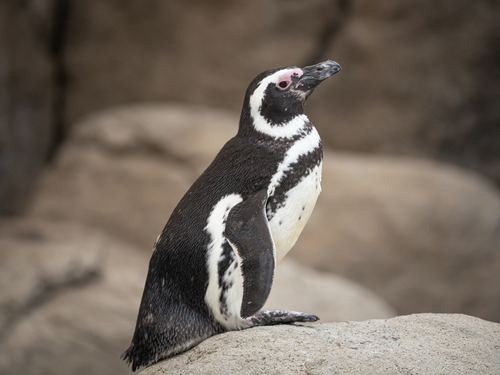
Magellanic Penguin
Spheniscus magellanicus
South America's most famous coastal bird, the Magellanic Penguin is a master of the surf and a diligent burrow-dweller. Named after the explorer Ferdinand Magellan, these tuxedoed travelers thrive in the rugged landscapes of Patagonia.
Quick Identification
Size
61–76 cm (24–30 inches) tall; weighs between 2.7–6.5 kg (6–14 lbs)
Colors
Blackish-grey upperparts and white underparts; features two distinct black bands on the chest and a white 'horseshoe' marking on the head
Key Features
- Two black bands between the head and breast
- White horseshoe-shaped stripe running from the eye to the throat
- Pink fleshy patch of bare skin around the eyes
- Black bill and webbed feet with sharp claws for climbing
When You’ll See Them
Sightings on EverydayEarth
May 5, 2026
A Magellanic Penguin is resting quietly in its burrow, tucked beneath a canopy of dry brush. The bird appears to be in a resting or incubating posture, occasionally shifting its head and blinking while settled into the sandy nest.
May 3, 2026
A Magellanic Penguin is seen tending to its nest under a protective canopy of dry branches. The penguin meticulously preens its chest feathers and carefully adjusts its position over a large white egg, occasionally lowering its head to check on the nest contents.
May 3, 2026
A Magellanic Penguin rests quietly in its nest, which is sheltered beneath the branches of scrubby coastal vegetation. The bird remains mostly still, occasionally blinking and shifting its weight slightly while looking around its immediate environment.
May 2, 2026
A Magellanic Penguin is seen resting quietly in its nest, sheltered under dry brush. It occasionally turns its head and blinks, staying alert but stationary throughout the observation period.
Apr 30, 2026
An adult Magellanic Penguin is positioned in its nest, which is built from twigs and soil under a dry bush. The penguin is seen leaning down to preen its feathers and nudging the contents of the nest bowl with its beak.
Apr 29, 2026
A Magellanic Penguin stands in a nest sheltered by dry, tangled branches. The penguin is seen preening its feathers, reaching around with its bill to groom its side and back.
Geographic range
Where Does the Magellanic Penguin Live?
Native to the southern tip of South America, the Magellanic Penguin is primarily found along the rugged coastlines of Argentina and Chile, as well as the Falkland Islands. During the winter months, these birds embark on a long migration northward, following cold currents as far as the shores of Uruguay and southern Brazil. While they are quintessential residents of the Southern Cone, they are occasionally spotted as vagrants much further afield in places like Australia, New Zealand, and even El Salvador.
Basemap © OpenStreetMap contributors
Recorded on EverydayEarth
Behavior
In the water, they are agile pursuit divers, capable of reaching depths of nearly 100 meters in search of prey. On land, they spend a significant amount of time preening their feathers with specialized oil from a gland near their tail, which maintains the waterproofing essential for survival in cold currents. They are generally monogamous, often returning to the same partner and the same burrow year after year after spending the winter months foraging at sea.
EverydayEarth exclusive
Camera Tips
Because these birds inhabit harsh coastal environments, a high-quality waterproof housing and a heavy-duty tripod or secure ground mount are essential. High winds and salt spray can easily topple a lightweight setup or cloud the lens, so regular maintenance is required. Use a wide-angle lens to capture the scale of a colony, or a telephoto setting if you are positioned further away to observe natural behaviors without causing stress to the birds. Since they are most active during the day, focus on standard daytime settings, but look for cameras with a fast trigger speed to catch them as they scuttle quickly across the sand.
Avoid using any form of food bait, as this can disrupt their natural foraging patterns and attract unwanted predators like skuas or foxes to the nesting area. Instead, look for natural bottlenecks like narrow gaps in coastal vegetation or specific beach entry points where penguins congregate before entering the water. During the peak breeding season (October through January), you'll have the highest chance of capturing chick-rearing behaviors and the chaotic energy of the colony. Always remember that these birds are protected; ensure your camera placement never blocks their path to the sea or their burrows.
Similar Species
Species that look similar or are commonly confused with Magellanic Penguin.
Frequently Asked Questions
Record Magellanic Penguin at your habitat
Connect a camera to start building your own species record — AI identifies every visitor automatically.