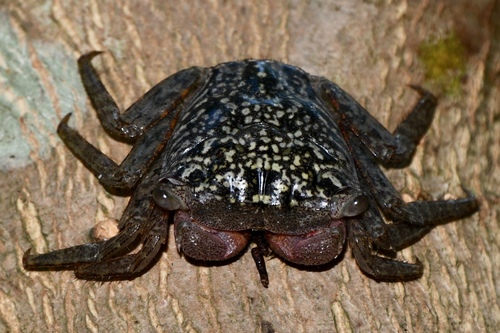
Mangrove Tree Crab
Aratus pisonii
The ultimate arboreal acrobat of the coast, the Mangrove Tree Crab is a tiny powerhouse that lives its life high above the waves in the tangled branches of the swamp.
Quick Identification
Size
Carapace width averages 2 cm (0.8 in); leg span up to 5-7 cm (2-2.8 in); weight approx. 5-15g (0.2-0.5 oz)
Colors
Mottled olive, brown, or blackish-grey carapace; legs often have dark spots and stiff black hairs; claws are typically yellowish or reddish-brown at the tips
Key Features
- Square-shaped carapace that is widest at the front
- Tapered, pointed legs specialized for climbing vertical bark
- Large, wide-set eyes located at the front corners of the shell
- Small tufts of black hair on the walking legs for grip
When You’ll See Them
Geographic range
Where Does the Mangrove Tree Crab Live?
Native to the tropical and subtropical coastlines of the Americas, the Mangrove Tree Crab is a staple of coastal ecosystems from central Florida and the Gulf of Mexico through the Caribbean islands. Its reach extends deep into South America, following the Atlantic coastline as far south as northern Brazil. While a distinct sibling species inhabits the Pacific coast, Aratus pisonii remains the dominant arboreal crab throughout the Western Atlantic and Caribbean mangrove belts.
Basemap © OpenStreetMap contributors
Behavior
The Mangrove Tree Crab is a master of the vertical world, spending nearly its entire life off the ground. Unlike typical crabs that scuttle along the seafloor, these agile crustaceans are expert climbers that navigate the complex root systems and canopies of mangrove forests. They are highly attuned to the tides, performing a daily vertical migration: as the tide rises, they climb higher into the branches to avoid predatory fish, and as the tide recedes, they descend toward the mud to forage.
These crabs are social but competitive, often congregating in high densities on a single tree. They are extremely wary of movement; at the slightest vibration or shadow of a predator (like a heron or a human), they will either freeze, scuttle to the opposite side of a branch, or leap directly into the water to escape. In the water, they are capable swimmers but prefer to return to the safety of the timber as quickly as possible.
EverydayEarth exclusive
Camera Tips
Capturing the Mangrove Tree Crab requires a specific approach because of their small size and arboreal lifestyle. Mount your camera directly onto a vertical mangrove root or a sturdy branch about 3 to 4 feet above the high-tide line. Because these crabs are sensitive to vibration, ensure the mounting is rock-solid. A camera with a short focal distance or macro capability is ideal, as the best shots will happen when the crab scuttles directly in front of the lens.
Timing is everything with this species. Program your camera to be most active during the two hours before and after high tide. This is when the crabs are forced to congregate on the trunks to stay dry, providing the highest density of subjects. Since they are fast movers, use the 'Burst Mode' or 'Photo + Video' setting with a high trigger speed (0.2s or faster) to catch them before they move out of frame.
While they are primarily leaf-eaters, you can entice them to linger in front of your camera by securing a small mesh bag of crushed shrimp or fish scraps to the bark nearby. The scent of animal protein is often irresistible to these opportunistic omnivores and will keep them in the frame longer than a mangrove leaf would. Ensure your camera is angled slightly downward to capture the texture of the bark, which helps show off their incredible camouflage.
Frequently Asked Questions
Record Mangrove Tree Crab at your habitat
Connect a camera to start building your own species record — AI identifies every visitor automatically.