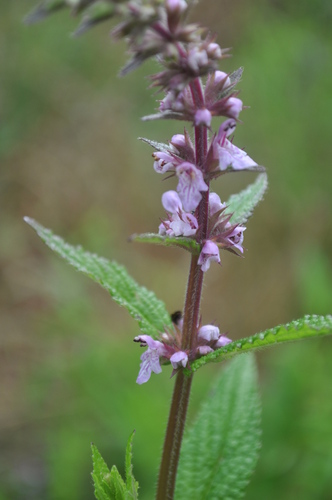
marsh hedge nettle
Stachys hispida
A hidden gem of the North American wetlands, the marsh hedge nettle stands out with its bristly stems and delicate, mottled purple flowers. It is an essential stop for native bees and a beautiful addition to any damp backyard sanctuary.
Quick Identification
Size
Grows 30–100 cm (12–39 inches) tall; leaves are 5–12 cm (2–5 inches) long
Colors
Light purple to pale pink flowers with darker purple mottling; bright green stems and foliage
Key Features
- Square stems with stiff, downward-pointing bristles along the angles
- Opposite, lance-shaped leaves with serrated margins and short petioles
- Bilabiate (two-lipped) flowers arranged in a terminal spike
- Lack of a strong aromatic 'minty' scent when leaves are crushed
- Hairs primarily restricted to the veins on the underside of leaves
When You’ll See Them
Behavior
Marsh hedge nettle is a hardy perennial that acts as a structural anchor in wetland ecosystems. Unlike many members of the mint family that spread aggressively through garden beds, this species tends to stay in somewhat well-behaved clumps, slowly expanding via underground rhizomes. It is a 'stay-put' species that relies on its height and vibrant floral display to compete with surrounding sedges and grasses in the dense growth of a wet meadow.
As a biological host, its primary 'behavior' is its interaction with the insect world. It serves as a vital nectar source during the mid-to-late summer months. While it doesn't move on its own, it is a hive of activity, providing a sturdy landing platform for bumblebees and long-tongued bees who are specialized enough to reach the nectar tucked deep within its tubular flowers. In a backyard setting, it acts as a magnet, bringing life to the dampest, often neglected corners of the yard.
EverydayEarth exclusive
Camera Tips
Capturing the marsh hedge nettle on camera requires a different strategy than photographing wildlife, as the plant itself is stationary but its visitors are fast. To get the best results, mount your camera on a low-profile stake or tripod at a height of approximately 18 to 24 inches. Angle the camera slightly upward toward the flower spike; this 'bug's eye view' highlights the intricate purple spotting on the lower lip of the petals and makes the plant look more majestic against the sky or background foliage.
Because this species thrives in wet areas, the lighting can often be harsh or highly contrasted. The best time for photography is during the 'blue hour' just before sunrise or the 'golden hour' before sunset. This soft, directional light emphasizes the bristly (hispid) texture of the stems, which is a key identification feature. If your camera has a 'Macro' or 'Close-up' mode, use it to focus on the middle of the flower spike, where the blooms are usually at their peak.
For those using AI-powered trail cameras, set the capture mode to 'Video' or 'Burst' with a high sensitivity. This will allow you to capture the rapid arrival and departure of pollinators like the Clearwing Hummingbird Moth or various leafcutter bees. Since the plant sways in the wind, try to position your camera on a day with low wind speeds to prevent 'false triggers' and ensure the AI correctly identifies the visiting insects rather than just the moving stalk.
Lastly, pay attention to the background. Marsh hedge nettle often grows in 'messy' habitats alongside tall grasses and reeds. Before setting your camera, gently pin back any surrounding blades of grass that might obstruct the view of the stem. This ensures that the camera's autofocus stays locked on the pink-purple flowers, resulting in crisp, professional-looking images for your collection.
Similar Species
Species that look similar or are commonly confused with marsh hedge nettle.
Frequently Asked Questions
Record marsh hedge nettle at your habitat
Connect a camera to start building your own species record — AI identifies every visitor automatically.