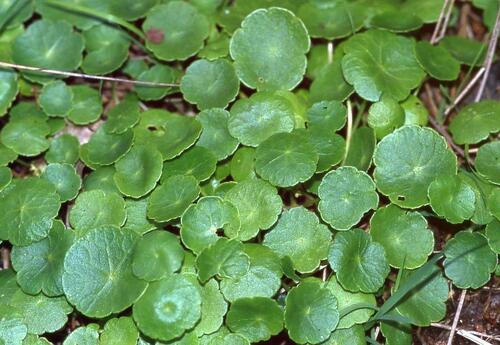
Marsh Pennywort
Hydrocotyle vulgaris
A charming, coin-shaped wonder of the wetlands, Marsh Pennywort creates lush emerald carpets across boggy gardens and pond edges. This hardy perennial is more than just a pretty leaf; it's a vital sanctuary for backyard amphibians and a natural purifier for your water features.
Quick Identification
Size
Leaves 2–5 cm (0.8–2 in) in diameter; creeping stems can reach 100 cm (3.3 ft) in length; height 5–15 cm (2–6 in).
Colors
Vibrant lime green to deep emerald leaves; stems are pale green or reddish; flowers are tiny, inconspicuous white or pale pink.
Key Features
- Circular, umbrella-like leaves (peltate) with the stem attached to the center
- Creeping horizontal stems (stolons) that root at every node
- Scalloped or lightly lobed leaf margins
- Low-growing, carpet-forming growth habit in wet mud or shallow water
When You’ll See Them
Behavior
Marsh Pennywort is a resilient, creeping perennial that thrives in the 'liminal' spaces between land and water. It spreads primarily through horizontal stolons—runners that creep across the mud or float on the water's surface, sending down roots and up new leaves at regular intervals. This growth habit allows it to quickly colonize damp areas, forming a lush, green mat that provides excellent cover for small amphibians and aquatic insects.
While it doesn't 'behave' in the traditional sense of an animal, it is highly responsive to its environment. Its leaves are phototropic, subtly tilting throughout the day to maximize sunlight absorption. In garden settings, it is often considered a 'money plant' or 'lucky plant' due to its coin-shaped leaves, and it acts as a natural bio-filter by absorbing excess nitrates and phosphates from the water, helping to keep backyard ponds clear.
EverydayEarth exclusive
Camera Tips
Capturing the Marsh Pennywort on an AI-powered camera requires a shift from motion-triggering to time-lapse settings. Because plants do not typically trigger PIR (Passive Infrared) sensors, configure your camera to take a photo at regular intervals—every 30 to 60 minutes—during daylight hours. Over a few weeks, this will create a fascinating visual record of the plant 'walking' across the soil or water surface as its stolons extend and new 'pennies' emerge.
For the best perspective, mount your camera very low to the ground using a short stake or a mini-tripod. An angle of 30 to 45 degrees looking down onto the leaves is ideal for showcasing the unique radial veins and the 'umbrella' structure of the foliage. If you are monitoring a pond, place the camera at the water's edge where the pennywort meets the surface; this is a high-traffic area for wildlife. Use the camera's AI to flag 'significant motion' in these zones, as the pennywort leaves are favorite sunning platforms for frogs and dragonflies.
Lighting is the 'make or break' factor for this species. The waxy surface of the leaves can cause harsh glares in direct midday sun, which might wash out the image. Aim for 'golden hour' captures—early morning or late afternoon—when the low sun illuminates the leaves from the side, highlighting their translucent quality and vibrant green hue. Ensure your camera is well-shielded from moisture, as the pennywort’s preferred habitat is naturally humid and prone to morning mist which can fog up your lens.
Frequently Asked Questions
Record Marsh Pennywort at your habitat
Connect a camera to start building your own species record — AI identifies every visitor automatically.