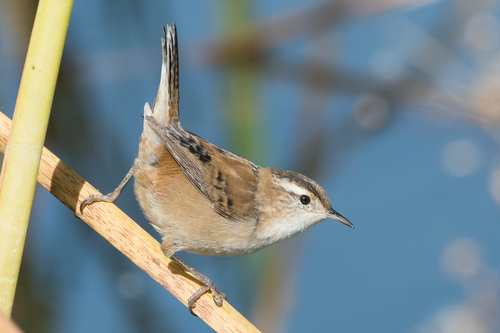
Marsh Wren
Cistothorus palustris
The spirited voice of the wetlands, the Marsh Wren is a master of camouflage and construction. Famous for building dozens of 'decoy' nests, this tiny bird's aggressive personality far exceeds its small stature.
Quick Identification
Size
Length: 10-14 cm (4-5.5 in); Wingspan: 15 cm (5.9 in); Weight: 9-14 g (0.3-0.5 oz)
Colors
Warm brown upperparts with a distinct black-and-white streaked triangular patch on the back; white or pale cream throat and breast; buffy flanks; dark cap and a white line above the eye.
Key Features
- Prominent white eyebrow stripe (supercilium)
- Black triangular patch on the upper back with white streaks
- Short, stiff tail often held upright or cocked
- Long, slender, slightly down-curved bill
When You’ll See Them
Geographic range
Where Does the Marsh Wren Live?
Native to North America, the Marsh Wren occupies a vast range spanning from the southern provinces of Canada through most of the continental United States and into central Mexico. In the summer, they are found across the northern and central U.S. and southern Canada, while wintering populations concentrate along the Atlantic, Pacific, and Gulf coasts, as well as throughout the southern United States and Mexico. While many populations are migratory, some coastal groups along the western and southern edges of their range remain year-round residents in their local wetlands.
Basemap © OpenStreetMap contributors
Behavior
The Marsh Wren is a bird of intense energy and surprisingly aggressive temperament for its small size. These birds are most famous for their complex social behavior involving 'dummy nests.' A single male may build up to 20 oval-shaped nests out of cattails and grass within his territory, though only one is used for raising young. This behavior serves to confuse predators and attract potential mates, showcasing the male's vigor and the quality of his territory.
Known as the 'vocal powerhouse of the marsh,' these wrens are more often heard than seen. They possess a rapid, gurgling, and mechanical song that they belt out day and night during the breeding season. In terms of social interaction, they are fiercely territorial and have been known to puncture the eggs of other marsh-nesting birds, including other Marsh Wrens and even Red-winged Blackbirds, to reduce competition for resources.
EverydayEarth exclusive
Camera Tips
Capturing a Marsh Wren on camera requires patience and a focus on their specific vertical habitat. Because these birds spend most of their time clinging to vertical stems of cattails or bulrushes, you should mount your camera at roughly chest height, angled slightly upward if you are at the water's edge. Look for 'dummy nests'—conspicuous football-shaped clumps of woven vegetation. Placing a camera with a fast trigger speed near one of these structures is your best chance for a clear shot, as the male will return to them frequently to maintain or defend them.
Since Marsh Wrens are fast-moving and often obscured by dense reeds, use a camera with high-speed video capabilities or a rapid burst mode for stills. The lighting in marshes can be tricky due to the contrast between dark shadows in the reeds and bright reflections on the water; if your camera allows, set a slightly higher ISO or use a center-weighted metering mode to ensure the bird is properly exposed. Early morning is the peak time for activity, as the birds are most vocal and active in defending their territory just after sunrise.
In a backyard setting, you are unlikely to attract Marsh Wrens unless your property directly borders a significant wetland or marshy pond. They do not visit traditional seed feeders. However, if you live near a marsh, maintaining a 'wild' buffer zone of tall grasses and native wetland plants can encourage them to venture closer to your lens. Avoid using acoustic lures excessively, as these birds are highly territorial and can become stressed if they believe an intruder is constantly in their space.
Similar Species
Species that look similar or are commonly confused with Marsh Wren.
Frequently Asked Questions
Record Marsh Wren at your habitat
Connect a camera to start building your own species record — AI identifies every visitor automatically.