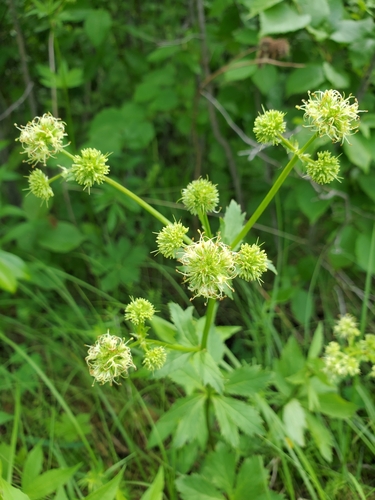
Maryland Sanicle
Sanicula marilandica
A stalwart of the North American woodland, the Maryland Sanicle is famous for its hooked 'hitchhiker' seeds and its historic role in herbal medicine.
Quick Identification
Size
Stands 45–120 cm (18–48 inches) tall with a spread of 30–60 cm (12–24 inches).
Colors
Deep green foliage; tiny greenish-white or creamy flowers; dark brown to black fibrous roots.
Key Features
- Large palmately compound leaves with 5-7 sharply toothed leaflets
- Small greenish-white flowers clustered in globular umbels
- Ovoid fruit covered in hooked bristles (burs)
- Stout, smooth, light green upright stems
When You’ll See Them
Geographic range
Where Does the Maryland Sanicle Live?
Maryland Sanicle is a quintessential North American native, found across a vast portion of the continent. It thrives from the rocky coasts of Newfoundland and Quebec in the north, stretching west across the Canadian provinces to British Columbia, and reaching south through the United States to the Gulf Coast and the mountains of New Mexico. While it is common in the Eastern and Midwestern states, it becomes increasingly rare and localized in the Pacific Northwest and parts of the Deep South, where it is often a protected species.
Basemap © OpenStreetMap contributors
Behavior
Maryland Sanicle, also known as Black Snakeroot, is a perennial wildflower that anchors itself in the forest floor using a thick, fibrous root system. Unlike many showy wildflowers, it focuses its energy on a sturdy architectural form, producing greenish-white flower clusters that appear in late spring and early summer. It is a long-lived species that slowly expands its footprint in stable woodland environments, providing a consistent presence in the understory.
While it doesn't 'behave' in the animal sense, it has a clever reproductive strategy. Its seed pods are covered in tiny, hooked bristles designed to catch on the fur of passing mammals or the clothing of hikers. This hitchhiking method, known as epizoochory, allows the plant to colonize new areas far from the parent plant. In historical contexts, it was highly valued by indigenous peoples and early settlers for various medicinal purposes, particularly for treating snakebites and respiratory issues.
EverydayEarth exclusive
Camera Tips
To capture Maryland Sanicle on an AI-powered camera, placement is everything. Since this plant doesn't move, you should focus on its unique structural features. Set your camera on a low tripod or ground mount to capture the 'looking up' perspective of the palmately compound leaves. This angle highlights the 5-7 leaflet structure that distinguishes it from its cousins. High-resolution macro settings are best for capturing the intricate hooked bristles on the fruit during the late summer months.
Because Maryland Sanicle is a favorite stop for small pollinators and its seeds are dispersed by animals, placing a camera nearby can reveal a secret world of backyard visitors. Use a 'Time Lapse' mode during the morning hours when the greenish-white flowers are most likely to be visited by small bees and flies. If your camera has a motion trigger, set the sensitivity to high to catch the subtle movement of insects or the larger animals that may brush against the plant to transport its burs.
Be mindful of lighting in the woodland environment. The dappled shade where Maryland Sanicle thrives can cause 'hot spots' in your images. Position the camera so the plant is backlit during the golden hour (late afternoon); this will make the fine hairs on the stem and the hooks on the seed pods glow, creating a professional-grade botanical shot. During the winter, you can still monitor the site to see how the dried stalks provide cover for small invertebrates.
Frequently Asked Questions
Record Maryland Sanicle at your habitat
Connect a camera to start building your own species record — AI identifies every visitor automatically.