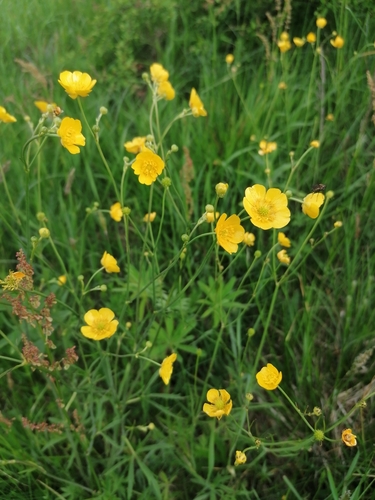
meadow buttercup
Ranunculus acris
The Meadow Buttercup is the 'tall' golden icon of summer fields, famous for its mirror-like petals that seem to glow under the sun. A favorite of hoverflies and bees, this vibrant wildflower adds a splash of liquid sunshine to any backyard meadow.
Quick Identification
Size
Grows 30–70 cm (12–28 in) tall; flowers are approximately 25 mm (1 in) in diameter.
Colors
Bright, glossy waxy yellow petals with a yellow-green center; deep green foliage.
Key Features
- Five shiny, heart-shaped yellow petals
- Round, hairy stems that are not furrowed or grooved
- Deeply divided palmate leaves with 3 to 7 lobes
- Tall, upright, and branching growth habit
When You’ll See Them
Behavior
In a backyard ecosystem, these plants act as a vital early-to-mid-summer buffet for pollinators. They produce a significant amount of nectar and pollen that attracts hoverflies, honeybees, and various small beetles. While they are beautiful, they have a chemical defense mechanism: when crushed or bitten, they release protoanemonin, a bitter, irritating oil. This helps them survive in pastures where livestock will grazing on surrounding grasses but leave the buttercups untouched.
EverydayEarth exclusive
Camera Tips
Because Meadow Buttercups sway significantly in the wind, a standard motion-trigger setting on a trail camera may lead to hundreds of empty photos of moving stems. To combat this, use a 'Time Lapse' mode or a 'Hybrid' mode with low sensitivity. Set the interval to capture a photo every 5 to 10 minutes during peak daylight hours. This will give you a beautiful progression of the flower heads tracking the sun throughout the day and increase your chances of documenting visiting insects like the Meadow Brown butterfly or various hoverflies.
Lighting is your best friend with this species. The petals are naturally reflective, so mid-day sun can sometimes 'blow out' the highlights in your photos. For the most professional-looking shots, aim for the 'Golden Hour'—the hour after sunrise or before sunset. The soft, angled light will catch the waxy sheen of the yellow petals without creating harsh glares. If you are setting up in a backyard, placing the camera so the sun is behind the flower (backlighting) can make the yellow petals appear to glow from within.
Finally, consider the seasonal transition. Meadow Buttercups are at their peak in early June. If you want to capture the full life cycle, keep your camera in place as the petals fall away to reveal the green, spiky seed heads (achenes). These structures are fascinating under a lens and provide a different aesthetic than the bright yellow blooms. Ensure you clear any fast-growing tall grass from directly in front of the lens to keep the focus sharp on the buttercup itself.
Similar Species
Species that look similar or are commonly confused with meadow buttercup.
Frequently Asked Questions
Record meadow buttercup at your habitat
Connect a camera to start building your own species record — AI identifies every visitor automatically.