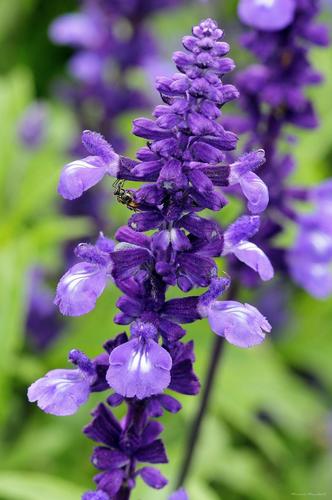
Mealy Blue Sage
Salvia farinacea
A tough-as-nails native beauty that brings the deep blues of the Texas sky to your backyard. Mealy Blue Sage is a pollinator powerhouse, offering a non-stop nectar feast for hummingbirds and butterflies all summer long.
Quick Identification
Size
Height: 12-36 inches (30-90 cm); Spread: 12-24 inches (30-60 cm)
Colors
Deep violet-blue or lavender-blue flower spikes; silvery-white 'mealy' dust on the calyx; glossy, bright green narrow leaves.
Key Features
- Tall, upright spikes of densely clustered violet-blue flowers
- Silvery-white, flour-like powder (mealy) coating the flower calyx and stems
- Shiny, narrow, lance-shaped leaves unlike the dull, fuzzy leaves of other salvias
- Square stems characteristic of the mint family
When You’ll See Them
Behavior
Mealy Blue Sage is a resilient herbaceous perennial that acts as a focal point for activity in the backyard. Unlike many other sages that have a matte or velvety texture, this species features glossy foliage that reflects light beautifully. It is known for its 'mealy' appearance—a white, powdery pubescence on the calyx that gives the plant its name and a frosted look. It grows in compact mounds and is exceptionally heat and drought-tolerant once established.
While the plant itself is stationary, its 'behavior' is defined by its role as a high-traffic nectar station. It is a top-tier pollinator plant, consistently attracting a wide variety of native bees, butterflies, and hummingbirds from late spring until the first frost. In the garden, it is non-aggressive and tends to stand upright even in windy conditions, making it a reliable subject for observation.
EverydayEarth exclusive
Camera Tips
When setting up an AI-powered camera for Mealy Blue Sage, think of the plant as a 'stage' rather than the sole subject. Because this salvia is a magnet for hummingbirds and large butterflies like monarchs and swallowtails, position your camera on a garden stake or tripod at a height of about 24 inches. Angle the lens slightly downward to capture the full length of the flower spikes. This ensures that when a hummingbird hovers to feed, both the bird and the vibrant blue blooms are in clear focus.
Lighting is crucial for this species due to the 'mealy' white coating on the stems. Early morning light (the 'golden hour') hits the silvery powder and makes the plant appear to glow, providing excellent contrast against the deep blue flowers. If your camera has a macro mode or adjustable focus, set it to trigger on the middle of the flower spike. Avoid placing the camera where it will be shaded by taller shrubs, as the Mealy Blue Sage needs the sun to keep its blossoms open and its nectar flowing, which in turn keeps the wildlife coming back.
For the best action shots, use a 'Fast Motion' or 'Burst' setting. Hummingbirds and clearwing moths move incredibly fast, and a standard shutter speed might result in a blur. If you are using a trail camera for video, set the clip length to at least 15 seconds to observe the social interactions between pollinators, as bees will often compete for the best spikes. During the peak of summer, check your lens for water spots if you use overhead irrigation, as the shiny leaves can reflect splashes back onto the camera glass.
Frequently Asked Questions
Record Mealy Blue Sage at your habitat
Connect a camera to start building your own species record — AI identifies every visitor automatically.